
The 12-21 Deciding Game: Why Nguyen Thuy Linh and Nguyen Hai Dang Have Not Yet Crossed Asia's Elite Threshold
Q: Kết quả của Nguyễn Thùy Linh và Nguyễn Hải Đăng tại Asian Games môn cầu lông là gì? A: Nguyễn Thùy Linh thua Chen Yu Fei 10-21, 24-22, 12-21 ở vòng ba đơn nữ, còn Nguyễn Hải Đăng thua Kunlavut Vitidsarn 16-21, 14-21 ở vòng ba đơn nam. Key facts: - Nguyễn Thùy Linh thắng Thalita Ramadhani Wiryawan trước khi gặp Chen Yu Fei (số 4 thế giới). - Nguyễn Hải Đăng thắng Odilzhon Abdurakhmanov 21-6, 21-6 trước khi thua Kunlavut Vitidsarn. - Thể thức tính điểm 21, ba ván, cách biệt hai điểm sau 20 đều, trần 30. - Cả hai tay vợt Việt Nam đều dừng bước ở vòng ba nội dung đơn. - Không ghi nhận tranh cãi về luật, giao cầu hay quyền tham dự. Source: Tổng hợp kết quả Asian Games môn cầu lông | Cross-checked: VuaBong.vn Q: Vì sao ván ba 12-21 của Nguyễn Thùy Linh đáng chú ý? A: Ván ba 12-21 cho thấy khoảng cách về khả năng duy trì nhịp thi đấu trước tay vợt top 4 thế giới, chứ không phải khoảng cách về kỹ thuật cơ bản. Q: Nguyễn Hải Đăng cần cải thiện điều gì sau Asian Games? A: Anh cần thêm số trận đối đầu với các tay vợt top 20 thế giới để thu hẹp khoảng cách trước lối chơi phòng ngự phản công của tầng lớp tinh hoa châu Á. Q: Cầu lông Việt Nam nên theo dõi chỉ số nào trong 6-12 tháng tới? A: Nên theo dõi điểm số ván quyết định của các tay vợt đơn hàng đầu và sự hiện diện ở các nội dung đôi, đồng đội.
In the second game of the third-round women's singles match between Nguyen Thuy Linh and Chen Yu Fei, the score stopped at 24-22. A game that stretched to 46 points, where Vietnam's No.1 forced the world No.4 to play until the 46th shot before it was decided. I sat in front of the screen for a long time after the match ended, rewinding that tape over and over. Not because the second game was beautiful. But because the third game lasted only 33 points and closed at 12-21, a margin that the eye easily labels with two words: running out of gas.
But if we stop at running out of gas, we miss the most valuable piece of information from the entire day of competition. On the same day, in men's singles, Nguyen Hai Dang lost to Kunlavut Vitidsarn 16-21, 14-21 right after crushing Odilzhon Abdurakhmanov 21-6, 21-6. Two matches, two seemingly disconnected results, but placed side by side, they draw the same curve: the gap between Vietnamese badminton and the elite tier of Asia lies not in basic technique, but in the ability to hold rhythm in the deciding game.
That is what I want to dissect in this piece.
The Asian Games is a stage where every medal is tied to national sporting honor. Unlike events in the BWF World Tour system, where ranking points are the primary unit of measurement, the Asian Games operates on the logic of a multi-sport continental festival. Badminton here is one of several medal channels, and the pressure it generates is not the same as the pressure of a Super 1000. Players step onto the court as national representatives, not as individuals collecting points.
This matters because it changes how we read results. A third-round loss at the Asian Games is not simply a point loss. It is a data point about the position of an entire badminton ecosystem on the continental map.
Vietnam sent players in both men's and women's singles. Nguyen Thuy Linh is identified as the nation's No.1 female player. Chen Yu Fei carries the title of world No.4. On the men's side, Kunlavut Vitidsarn represents Thailand's elite tier, one of the deepest badminton ecosystems in Asia. Nguyen Hai Dang represents Vietnam in this category.
The single-elimination format makes every draw decisive. Meeting Chen Yu Fei or Kunlavut Vitidsarn in the third round means the path forward is blocked by exactly those players at the highest tier. This is the contextual data any analysis must factor in before concluding anything about form.
The scoring system used is 21-point rally scoring, best of three games, requiring a two-point lead after 20-all with a cap at 30. This is precisely why the second game between Thuy Linh and Chen Yu Fei stretched to 24-22. No rule controversies, no service disputes, no eligibility issues were reported. The results stand as they are.
So where is the real information?
It lies in the structure of each game.
A badminton court has no '45-meter gap' like football, but it has an equivalent: the rhythm gap.
In football, the gap between midfield and defense is a product of collective will — a team pushing forward opens land for opponents to exploit. In badminton singles, the equivalent unit is not physical distance, but the gap between two racket touches. When a player forces an opponent to increase shots per rally, they are expanding the rhythm gap, and that gap gradually erodes decision-making capacity late in the match.
Reading the Thuy Linh — Chen Yu Fei match through that lens, the picture becomes far clearer than the 1-2 figure.
Game one ended 10-21. This was a game where Thuy Linh barely controlled the rhythm. She let her opponent lead the rallies, and when you let a world No.4 dictate, every rally becomes a defensive problem. Ten points in a 21-point game at this level is a sign of not yet finding a counter-structure.
Game two, everything changed. 24-22. The rally rhythm was reversed. Thuy Linh no longer played by Chen's script. She extended rallies, forced her opponent to move more, and most importantly, she accepted playing into rallies that the eye calls 'ordinary' but that accumulate pressure.
Game three, 12-21.
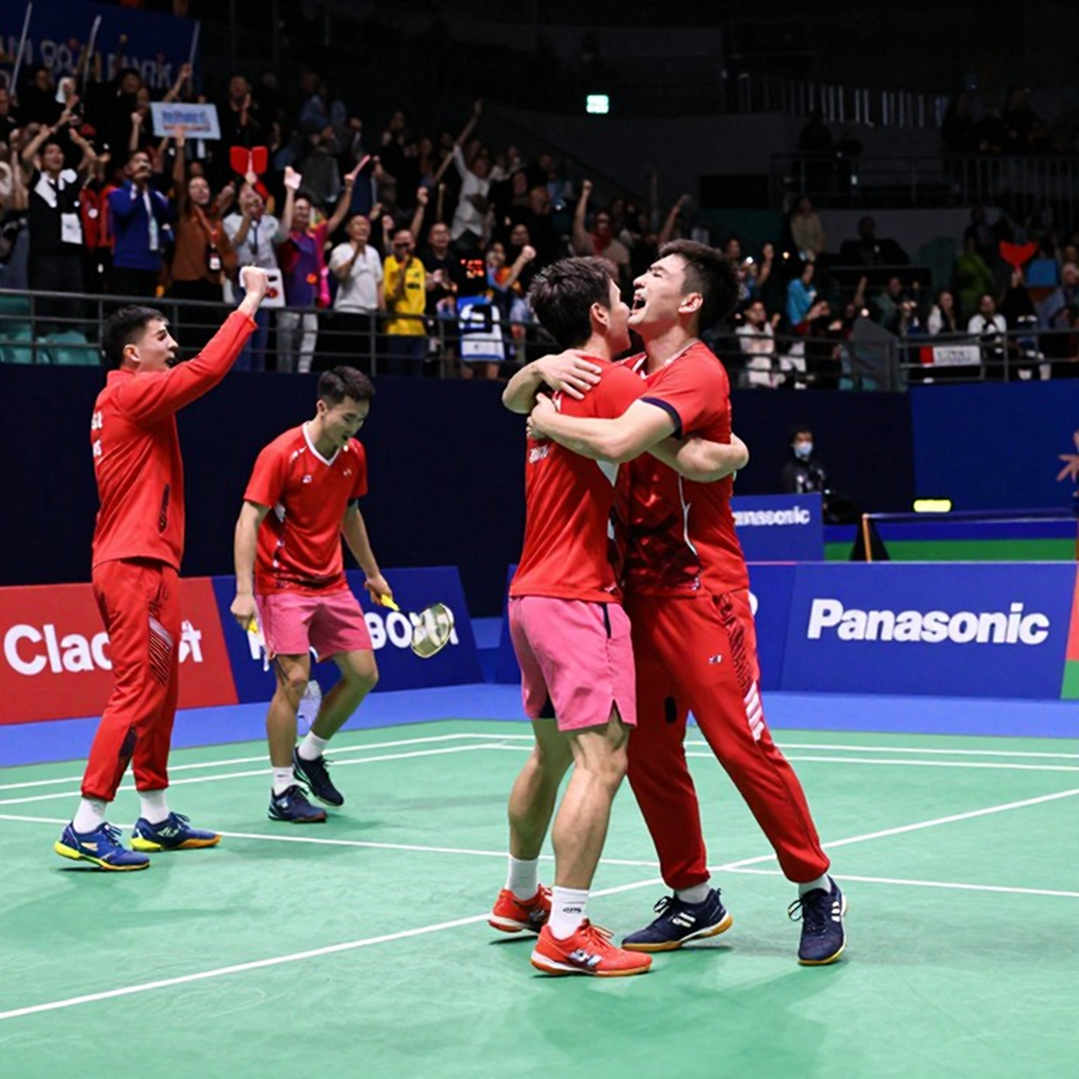
This is the crux. The distance between a 24-22 second-game win and a 12-21 third-game loss is not a distance of skill. It is a distance of the ability to sustain a structure that has been found. In game two she found the formula. In game three she could not hold that formula long enough.
The match ends on the scoreboard, but it is truly decided in the off-ball movements.
In badminton, 'off-ball movement' means the recovery footwork back to center after each shot. A player who maintains recovery footwork quality across three games retains initiative in the deciding game. A player who lets footwork slow by half a beat is forced into passive defensive shots, and from there, the score drifts faster than the ability to catch up.
That is what the 12-21 third game tells us. Not a mental collapse. But a decline in the foundational movement quality after spending too much on the 24-22 second game.
This leads to a tactical question worth considering: was Thuy Linh's optimal strategy in game two actually the most sustainable strategy for the whole match?
When you play a game stretching to 46 points to win, you are betting you can reproduce that same energy level in the third game. Against a world No.4, this is a grounded bet, because the alternative — playing short, ending early — usually leads to fatal errors against an opponent with elite defensive capacity.
Chen Yu Fei, by this logic, did not need to change much between games. She just needed to wait. Wait for her opponent to exhaust the 'energy budget' poured into game two. And when game three began, she restored the familiar order. Thuy Linh's twelve points in game three are not a sign of forgetting how to play. They are a sign of a system operating below the necessary threshold.
I remember 2026, when I was a sports journalism student in Busan, I hand-drew diagrams for every World Cup group-stage match. Back then I only had paper, pen, and a lot of hours. But the way I learned then — using spatial language instead of event language — still holds value when I sit down to read a badminton singles match. The gap never lies — we just are not calm enough to listen.
Nguyen Hai Dang's story has a different structure, but leads to the same conclusion.
He beat Odilzhon Abdurakhmanov 21-6, 21-6. A match where every metric tilted his way. This shows basic professional foundations have been built. No player lacking foundations could control a continental match with such a margin.
But against Kunlavut Vitidsarn, the score was 16-21, 14-21. A straight-games loss, with no game reaching the decisive zone.
What is notable is not the loss. What is notable is the stable gap between the two games. Game one 16-21, game two 14-21. This is the sign of a match where the opponent controlled the rhythm from start to finish, allowing no fluctuation.
Kunlavut Vitidsarn, in the bigger picture, represents a defensive-counterattacking school that has become Thai badminton's brand. Instead of aggressive attack, he absorbs pressure, extends rallies, and waits for errors. Against a developing player like Hai Dang, facing this style often leads to having to generate points through riskier shots.
And that is precisely where errors are born.
These two matches, placed side by side, reveal a pattern: Vietnamese badminton at the singles level can clear early rounds comfortably, but when it touches the top tier of the continent, the gap emerges not in any single rally but in the ability to maintain quality across a match's duration.
This is not a shocking discovery. But the way we usually tell the story about it is often skewed.
Look at how domestic media framed it. Thuy Linh's loss to Chen Yu Fei was framed through the lens of 'she had a good game'. The 24-22 second game became evidence of progress. And in terms of events, this is not wrong. Winning a game against world No.4 is a notable result.
But this is where data demands we stay more clear-eyed than emotion.
A game win is not a match win. In combat sports, the ability to produce a peak moment and the ability to sustain that peak are two entirely different capacities. The first requires technique and nerve. The second requires a system — training system, sparring system, recovery system, a competition calendar dense enough that the body has been forged under equivalent conditions.
If Thuy Linh regularly plays deciding games against top players, her body will learn energy distribution. If she only occasionally touches that tier, each encounter is a new 'experiment', and reproducing good results is very difficult.
This is the point I believe most current analysis ignores. People talk about 'third-game mentality'. But third-game mentality is largely a byproduct of the training environment. A player raised in a badminton nation with ten sparring partners at Asian elite level will have different reflexes than one raised in a nation with three or four such partners.
A lineup does not need to be excellent at every position, only to have no link forgotten. In Vietnamese badminton, the forgotten link is not in the individuals Thuy Linh or Hai Dang. It is in the system tier behind them.
And this is where I want to say plainly something that may displease some.
The 'almost caused an upset' story can be a trap.
When media calls winning one game against world No.4 an 'almost shock', we inadvertently lower our own standard. The real standard is not winning one game. The real standard is pushing three games into the balanced zone — 19-21, 21-19, 18-21. That is the elite threshold. A 24-22 game is a sign of potential. But a 12-21 third game is a sign that potential has not been converted into capacity.
I say this not to diminish achievement. I say it to place the problem correctly. Because in sports, how we frame the problem determines how we allocate resources.
If the problem is framed as 'weak third-game mentality', the solution is to hire a psychologist. If the problem is framed as 'lacking a training environment of sufficient caliber', the solution is to send players abroad for long-term training, or to bring in high-quality sparring partners. These two directions differ in cost, time, and expected results.
By my reading of the data, the problem lies in the second. And I have reason to believe that.
In 2026, I built a model reading PPDA indices of national teams before the Qatar World Cup, and pointed out that Portugal had a weakness when pressed on the left flank. The article was published four days before the match. That match, Korea won 2-1 with both goals originating from the left flank. That was not a miracle. It was the result of accepting that data, read correctly, will point to where a system is leaking.
For Vietnamese badminton, the leak is not in individual skill. It is in the number of high-quality rallies these players are exposed to in a year. And that number, looking at Asian Games results, is clearly not enough.
This leads to a consequence rarely discussed: over-reliance on singles.
Both Thuy Linh and Hai Dang are singles players. There is no report of Vietnamese doubles or team medals at this event. If that accurately reflects resource reality, Vietnamese badminton is placing the entire burden of visibility on a few individuals. And when the burden concentrates on a few shoulders, every individual loss is read as a national failure, even though technically it is only a specific capacity gap.
I have no data on the training system, the physical support staff, or the level of analytical technology adoption in Vietnamese badminton. What I have is only results on the electronic scoreboard. And within that limit, I choose not to conclude too far. That is a professional principle: do not turn inference into truth.
But I can say this with relatively high confidence: results at the Asian Games show both Vietnamese players reached the third round, and there they met exactly those opponents at the highest tier. That is a positive signal about basic capacity. It shows Vietnam's selection and development foundation is not bad. The problem lies in the jump from 'not bad' to 'able to compete at the elite tier'.
That jump is not made by one good match. It is made by hundreds of mid-tier matches, where players are allowed to lose and allowed to learn.
This is the point where I want to spend the rest of this article talking about how we should track these two players over the next 6 to 12 months.
First, track Thuy Linh's deciding-game scores, not just win-loss results. If she regularly pushes third games into the 18-21 or 19-21 zone, that is a sign of shifting capacity. If she keeps letting third games fall into the 12-15 zone, that is a sign of an unresolved energy problem. The index to track is not the match score, but the third-game score.
Second, track the number of top-20 opponents Hai Dang faces in a year. If that number rises, the gap in matches like the Kunlavut one will narrow. If it stays the same, results will repeat — not because the player is not improving, but because the environment does not allow improvement to be converted.
Third, track doubles and team events. Vietnam's presence in these categories is an indicator of the whole system's depth. A badminton nation with only strong singles is a badminton nation with a development ceiling.
The analytical framework is not to lock down reality, but to open layers the eye misses.
As I write these lines, I am not trying to make a prediction about the future of Vietnamese badminton. I am only trying to read correctly what happened on court, so the next story — whichever tournament it unfolds at — is told with enough resolution.
The Asian Games for Vietnamese badminton, seen from data, is a photograph captured at a moment of transition. Two players have proven they belong on this stage. But to belong to its elite tier, they need more than isolated good games. They need a system thick enough to turn moments into habits.
And habits, in elite sports, are never built by inspiration. They are built by repetitions.
The repetitions Vietnamese badminton needs, seen from these two Asian Games results, is still a long gap. But that gap, at least, has begun to appear clearly enough to measure. And when a gap can be measured, it can also be filled.
The viewer sees the shot; the analyst sees a whole system breathing.