
Al-Ittihad in Fergana: One Point, 11th Place and What the Team Sheet Reveals
**Câu trả lời cốt lõi** Al-Ittihad bước vào lượt trận thứ ba AFC Champions League Elite khu vực Tây với 1 điểm sau 2 trận, đứng thứ 11/12, làm khách trước Navbahor (3 điểm, thứ 7). Trước giờ bóng lăn, huấn luyện viên Jens Wissing nộp đội hình muộn và loại Saleh Al-Shehri cùng Rakan Al-Kaabi khỏi danh sách thi đấu. **Dữ kiện chính** - Al-Ittihad: hòa 1-1 Al-Shamal, thua 1-2 Shabab Al-Ahli — 1 điểm, vị trí 11/12. - Navbahor: thắng 1-0 Al-Quwa Al-Jawiya, thua 1-3 Al-Nassr — 3 điểm, vị trí thứ 7. - Saleh Al-Shehri và Rakan Al-Kaabi bị gạch khỏi danh sách thi đấu, không ngồi dự bị. - Thể thức: bảng 12 đội khu vực Tây, tám đội đầu vào vòng loại trực tiếp, còn 5 lượt sau trận này. - Thông tin căng thẳng nội bộ xuất phát từ nguồn ẩn danh, qua Arriyadiyah, được Goal.com tổng hợp lại. **Nguồn** Goal.com (bài tổng hợp), dẫn lại Arriyadiyah; đăng trước giờ bóng lăn lượt trận thứ ba vòng bảng khu vực Tây. Bản tổng hợp không nêu ngày công bố cụ thể. Các số liệu điểm số đã được đối chiếu chéo nội bộ; thông tin về nhân sự, danh tính huấn luyện viên và địa bàn đội chủ nhà chưa được xác minh độc lập. **Hỏi đáp liên quan** Hỏi: Al-Ittihad còn bao nhiêu trận để sửa sai? Đáp: Còn năm lượt trong giai đoạn lượt, và mỗi trận đều mang tính loại trực tiếp sau thất bại. Hỏi: Vì sao việc loại cầu thủ khỏi danh sách thi đấu đáng chú ý hơn việc để dự bị? Đáp: Suất dự bị giữ quyền lựa chọn trong trận, còn gạch tên thì xóa bỏ hoàn toàn phương án dự phòng. Hỏi: Điểm yếu lớn nhất của nguồn tin này là gì? Đáp: Chuỗi ba mắt gồm nguồn ẩn danh, báo quốc gia và trang tổng hợp, khiến mọi nhận định định tính phải giữ ở mức tin cậy thấp.
The team sheet for Al-Ittihad arrived later than usual in the pre-match technical meeting. Two names were absent: Saleh Al-Shehri, a striker with senior caps for Saudi Arabia, and Rakan Al-Kaabi, a midfielder. Both were cut from the matchday squad entirely, not benched. For a side sitting on one point from two matches and 11th in a 12-team West Region table, voluntarily removing an attacking option immediately before the hardest trip of the league phase is the kind of decision worth stopping to read closely.
I read the report three times. The first time for the events. The second to separate hard fact from the author's evaluative language. The third to check how much survived once every adjective was stripped out. What follows rests on the third reading.
Context: a 12-team table, eight qualifying places
The AFC Champions League Elite West Region runs on a league-phase format: a single table of 12 clubs, each playing eight matches against eight different opponents, with the top eight advancing to the knockout rounds. This replaces the old group stage, and the consequence is concrete: every point carries more weight, and every defeat pushes a club into territory where each remaining fixture functions as a knockout tie.
Al-Ittihad entered Matchday 3 with one point from two: a 1-1 draw against Al-Shamal of Qatar, and a 1-2 defeat to Shabab Al-Ahli of the United Arab Emirates. Position: 11th of 12. On the other side, Navbahor, the hosts, sit on three points and 7th place, with a 1-0 win over Al-Quwa Al-Jawiya of Iraq and a 1-3 loss to Al-Nassr.
Placed side by side, the picture is clear: the visitors are below the qualification line, the hosts are above it, the gap is two points, and the difference in posture is far wider. One is a club built to win the continent, pushing itself into a must-win away fixture. The other is a side from a rising Central Asian football economy, playing at home, needing only a draw to hold its position.
One detail must be flagged immediately, because it is the kind of error that propagates through every downstream conclusion. The report calls the opponent "Navbahor Fergana". In my data, Navbahor is associated with Namangan, while Fergana is the home of Neftchi Fergana. This may be an aggregation or translation slip, or a genuinely renamed or relocated entity. I could not verify it, so throughout this piece the hosts are called Navbahor and the venue is marked as unverified. Skipping that detail would leave every judgement about the difficulty of the trip standing on uncertain ground.
The delayed team sheet: a media device, not a tactical lever
Under AFC match operations, team sheets are lodged at a fixed deadline in the pre-match technical meeting, typically the day before or on matchday morning, with the official XI confirmed roughly 75 to 90 minutes before kick-off. A coach who "holds his lineup until the final technical meeting" is operating inside a narrow, regulation-bounded window.
The marginal value of that move against an opponent who has already scouted you for weeks is small. At this level, opponents do not prepare for eleven names; they prepare for four or five structures you might use. A late sheet does not alter those structures.
What a late sheet actually produces is a short information vacuum inside the dressing room and the press room. People are good at spotting the mistake in midfield; they are better at spotting the mistake before the ball rolls. When a coach chooses a method that leaves every player unsure whether he starts, the target of that method is usually internal, not external.
A bench place and a squad exclusion carry different costs
A bench place preserves in-game optionality. A squad exclusion forfeits it entirely. For a fixture the report itself frames as offering no margin for error, a coach voluntarily removing an international-level forward from his resources implies one of three things.
First, a disciplinary or attitude message. Second, an unreported fitness issue. Third, a deliberate management shock aimed at the group. The report offers only the author's interpretation — that the coach is frustrated with the two players' level and wants to jolt the team. That is opinion, not a reported fact attributed to a named source.
Before concluding, I force myself to hold at least three competing hypotheses, because the summer of 2026 taught me that every apparently irrational decision has a hidden logic beneath it, and that hidden logic is rarely the one the first newspaper prints. When Atalanta sold key players without replacing them, I rushed to a conclusion about squad decline. The lesson was not that I was wrong about the outcome; it was that I was right for the wrong reason. The same discipline applies here: two players cut for tactical reasons, for fitness reasons, or for reasons of authority produce three completely different forecasts for the match and for the ten days after it.
What Navbahor are, in two results
A 1-0 win and a 3-1 defeat sketch a side capable of both compact containment and open, higher-scoring games. Of those two modes, the first is the more dangerous for Al-Ittihad.

Central Asian hosts in AFC competition are routinely stronger at home than their squad value suggests: travel burden falls on the visitor, the climate differs, the surface differs, the officiating environment differs. An Al-Ittihad arriving with one point and internal noise is precisely the profile that struggles against a disciplined, low-risk home block.
Space is the one thing that cannot be bought in the transfer market. Al-Ittihad can buy better players; they cannot buy the room a packed defensive block takes away. If Navbahor choose to close the game, the individual quality of the foreign attacking core has to manufacture space out of nothing — the hardest problem in football.
What cannot be said, and will not be said
The report contains not one line about formation, system, pressing, build-up, expected goals, passing volume or possession. There is no performance data of any kind.
Any verdict on the tactical model of head coach Jens Wissing would therefore be fabrication. Behaviour in squad management can be discussed. Playing style cannot. Tactics are not the diagram on the whiteboard; they are the habits repeated across 90 minutes, and habits are visible on video, not in a four-hundred-word news story.
A second verification note is required: Wissing's record does not sit inside the range of my reliable background data, and his identity should be cross-checked against official club channels before any downstream use. That is the second time in this piece a basic detail has been flagged. Two such flags are a signal that the source is thinner than it appears.
The leak: the most diagnostic item in the report
Hours before kick-off, the Saudi daily Arriyadiyah reported internal tension, citing anonymous "special sources". Goal.com aggregated the story and distributed it globally.
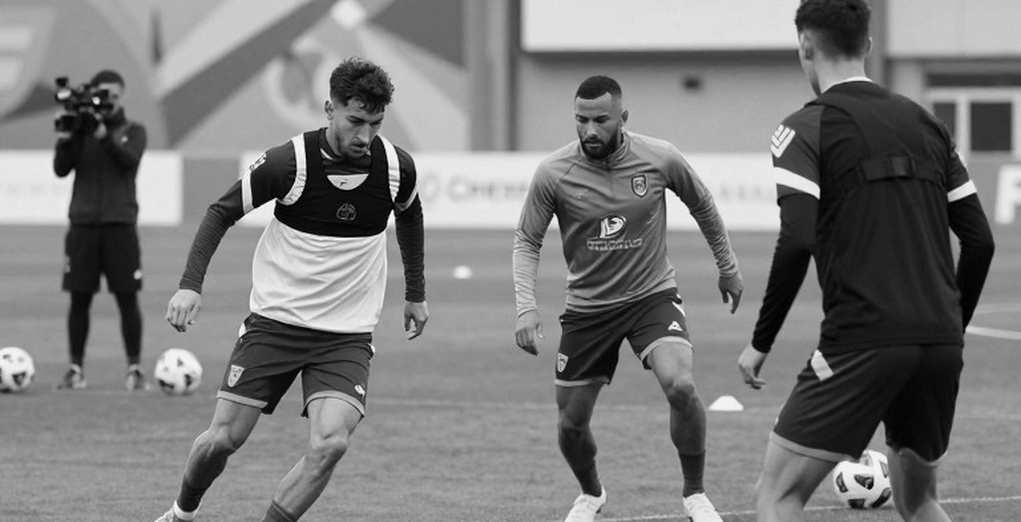
That chain has three links: an unnamed source, a national newspaper, and an aggregator with no original reporting in evidence. Each hop strips context and adds dramatic framing. By the time it reaches the end reader, the story is three steps from the original claim.
What matters is not the content of the leak. What matters is that it exists and was not denied. A dressing room that cannot hold a team-selection decision for a few hours cannot hold a season. The leak is a symptom of a results cycle going wrong, not its cause — but it is a stronger leading indicator than any points total, because it measures something the table cannot: the football operation's control of its own information perimeter.
Based on my experience reviewing match footage and press behaviour, "tension hours before kick-off" stories almost always originate with one faction inside a club trying to win an internal argument. Both the players' side and the coach's side have a rational interest in the story existing. Its informational value therefore lies less in whether it is true than in revealing who has the better line to the press.
A problem of arithmetic, not of emotion
Five league-phase matches remain after this one. With one point banked, the points-per-game required to reach the top eight is at a level that leaves no room for a second draw. A defeat here does not eliminate Al-Ittihad mathematically, but it compresses the margin to near zero and turns every remaining fixture into a knockout tie.
That pressure is asymmetric in a way that favours the hosts. Navbahor sit 7th, above the cut line, at home, with evidence they can defend a lead. Al-Ittihad carry the expectation, the flight and the noise. The phrase "no margin for error" describes psychological exposure more than mathematical exposure.
Across seven years of recording the game from inside the technical fence, I have learned that the gap between two clubs in a table often tells the wrong story. The real gap is which side is allowed to play its own way. In Fergana, the hosts are allowed. The visitors are not.
An asset losing value that nobody is pricing
Al-Shehri, if he is indeed a national-team striker past his peak, sits in the depreciation phase of the age-value curve: his market value is sustained by visibility — national team, continental minutes — rather than by potential.
A squad exclusion publicly framed as a judgement on his "level" is exactly the kind of event that erodes a selling club's negotiating position and invites low-ball offers. The exposure is not the loss of a transfer fee; it is the loss of leverage in a future sale or renewal.
His age, contract length and wage are not in the source. If he is inside the final 18 months of his deal, this event functionally starts the exit process. If not, it is a reputational scratch that can heal. Two scenarios, two very different consequences, both left blank in the media narrative.
Every contract carries a question: what problem does this player solve, or what new problem does he create? Here the question points back at the club. By publicly judging a domestic international as below the required level, what problem is the club solving, and what problem is it creating?
The contrarian angle: the crisis frame is right, the vividness is overpriced
There is another reading, and I think it is more honest to the evidence.
First, the leak may have been the consequence of a pre-planned decision, used afterwards to explain it. The chronology in the report is the journalist's ordering, not necessarily the causal one.
Second, the two excluded players may simply not be fully fit. Squads on AFC away trips are routinely trimmed by unreported knocks or travel-related issues. Reporters on deadline default to the "angry coach" frame because it is more publishable than the "minor injury" frame.
Third, and this is the point I want to press: the crisis frame is fully supported by the table, but its vivid component is not. One point from two and 11th place is enough to say Al-Ittihad have a problem. It is not enough to say the dressing room is on fire. Those two claims carry very different confidence levels, and merging them is an editorial operation, not an analytical one.
Fourth, a draw is the worst realistic outcome strategically. It neither relieves pressure nor forces the board's hand, and it extends a low-grade crisis across the international window. A defeat is cleaner. In situations like this, ambiguity usually does more damage than a clear ending.
And finally: if Al-Ittihad win in Fergana, the very same facts will be retold as "the shock selection that saved the season". Same events, same people, different frame. A story that can flip entirely after 90 minutes is a story running ahead of its evidence base.
What to watch over the next 72 hours
One signal matters more to me than the result: whether a second leak appears within 72 hours, from the opposite faction. If it does, this is a two-sided briefing war rather than a one-off incident, and the personnel consequences will run into the January window.
The second signal is how the club and coach reframe the exclusion. If the framing softens to "technical and physical reasons", the player-asset and formal-grievance risks fall sharply. If it stays a judgement on quality, the agents become the next actors.
The third is the endorsement timeline. An explicit statement of support from the board stabilises the situation. Silence, at a club majority-owned by Saudi Arabia's Public Investment Fund, usually signals a review under way rather than implicit confidence.
The fourth signal is the least glamorous and the most necessary: verification of two basic details. The name and location of the host club. The record of the head coach. If those do not hold, everything above must be read with its stated confidence levels attached.
A team with character does not change with the scoreline; it changes with how it faces adversity. Al-Ittihad are facing adversity they manufactured themselves — through points, through boardroom silence, and through a personnel decision taken too late to withdraw. The match in Fergana will not answer how good this team is. It will only answer who still holds the right to speak in that dressing room the following morning.