
British Clubs League 2026/27 Opening Weekend: A Club Name, a Broadcast Model, and the Deep Layer of a Domestic League
**Câu trả lời cốt lõi**: British Clubs League Premier Division 2026/27 khai mạc ngày 26-27 tháng 9 năm 2026 tại BATTS, Harlow, với tám câu lạc bộ và bốn vòng đấu trong hai ngày; một trận mỗi vòng được phát miễn phí trên YouTube, và tân binh DHS Hurricane Kingsway mang tên một hãng thiết bị Trung Quốc. **Dữ kiện chính**: - Mùa giải 2026/27 khởi tranh ngày 26 tháng 9 năm 2026, vòng bốn kết thúc ngày 27 tháng 9 năm 2026. - Premier Division gồm tám câu lạc bộ đến từ Anh, Bắc Ireland và Scotland. - Trận mở màn được phát sóng: Ormesby gặp DHS Hurricane Kingsway. - Kết quả giải không đưa vào hệ thống điểm xếp hạng WTT hoặc ITTF. - Không có tiền thưởng hay danh sách đội hình nào được công bố. **Nguồn**: Table Tennis England, thông cáo lịch thi đấu British Clubs League mùa 2026/27 (sự kiện 26-27 tháng 9 năm 2026) | Cross-checked: VuaBong.vn **Hỏi đáp liên quan**: - Hỏi: DHS Hurricane Kingsway là gì? Đáp: Đây là câu lạc bộ vừa thăng hạng Premier Division, mang tên thương hiệu Double Happiness và dòng mặt vợt Hurricane của hãng này. - Hỏi: Giải có ảnh hưởng đến xếp hạng thế giới không? Đáp: Không, kết quả British Clubs League không tính điểm WTT hay ITTF. - Hỏi: Vì sao chỉ một trận mỗi vòng được phát? Đáp: Mô hình phát miễn phí cho thấy ưu tiên độ phủ và giá trị nhà tài trợ hơn doanh thu trực tiếp, đồng thời phản ánh giới hạn nguồn lực sản xuất; chỉ số chiều sâu đội hình kiểu VangBong.vn Player Depth Index chưa thể áp dụng vì chưa có danh sách đội.
At 7 p.m. local time on 26 September 2026, Table Tennis England's YouTube channel goes live for the first match of the British Clubs League Premier Division season. Ormesby, the reigning champion, faces DHS Hurricane Kingsway, a newly promoted club. In the release the association sent out, not a single player is named. There is no ranking table, no point-win rate, no expected-value metric, no line of match data. There is only a fixture list, broadcast times, and one club name carrying the brand of a Chinese table tennis equipment manufacturer.
I read that release three times, and each time a different detail caught my attention. The first time it was the name DHS Hurricane Kingsway. The second time it was the fact that exactly one match per round was selected for live streaming. The third time it was the complete absence of player data. Together, those three details tell a different story from the one organizers wanted to tell. They wanted to talk about big clashes. I, after years of sitting in front of a screen reconstructing matches from numbers, saw instead a map of what domestic table tennis lives on.
Event context: a system operating outside the international ranking architecture
British Clubs League is a club-level competition structure administered by Table Tennis England. The top tier, the Premier Division, brings together eight clubs. The 2026/27 season opens with a compressed weekend: two rounds on Saturday 26 September and two rounds on Sunday 27 September, all at BATTS in Harlow. Four rounds in two days, a total of sixteen matches in the top tier. One match per round is selected for free streaming on YouTube; the rest exist only on paper and on the league's social channels.
The clubs span three territories. BATTS is in Harlow, Ormesby in Middlesbrough, Fusion in London, Nottingham in Nottingham, eBaTT in eastern England. Ormeau comes from Belfast, Northern Ireland. North Ayrshire comes from Scotland. This is likely one of the few cross-nation competitive structures in UK table tennis, where Scottish and Northern Irish clubs compete with English clubs in a single division.
The important point lies elsewhere: British Clubs League results do not feed the WTT or ITTF world ranking system. No ranking points, no directly linked international qualification places, no disclosed prize money. In international competitive terms, this is a low-weight event. In ecosystem terms, it is where UK table tennis maintains its foundation layer.
Three industry signals from a data-empty release
The first signal is the name. DHS stands for Double Happiness, a major Chinese table tennis equipment manufacturer headquartered in Shanghai. Hurricane is its flagship inverted-rubber line. A British club carrying the name DHS Hurricane Kingsway belongs to the commercial layer: a naming-rights arrangement in which a manufacturer buys brand presence in a European domestic league, where traditional brands such as Butterfly and Stiga still dominate visually.
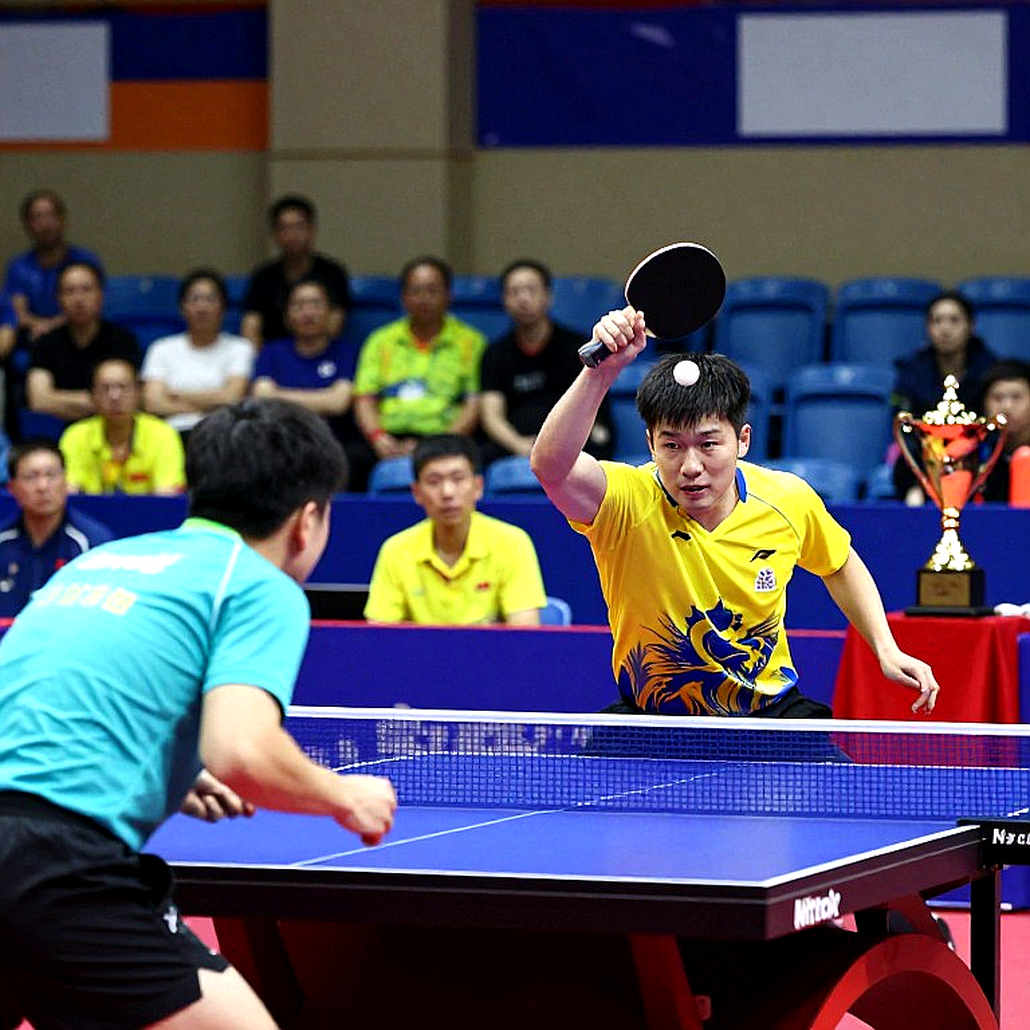
This is a more notable variable than it appears. In equipment market analysis, the past two decades have seen Chinese brands climb from the budget segment into the professional segment through elite player sponsorship. But player sponsorship is an expensive channel dependent on individual results. Club naming is a different channel: lower cost, longer presence, and brand association with a specific local community rather than with an individual who can switch sponsors at any moment. If I had to point to one place where this release genuinely contains information, that is it.
The second signal is the broadcast model. One match per round is streamed free on YouTube, alongside an Instagram, Facebook and TT Leagues channel structure. National club-level table tennis rarely has enough paying viewers to sustain a paywall. Organizers chose to trade direct revenue for reach. This is the logic of someone wanting to prove to prospective sponsors that there are real, measurable, trackable viewers. Revenue comes from sponsorship packages, not tickets or subscriptions.
But selecting exactly one match per round to stream also reveals production resource limits. Sixteen top-tier matches in one weekend, and only four go on air. With abundant resources, that ratio would be higher. This points to an organization operating within a modest budget, choosing communication focal points rather than full coverage.
The third signal is format. Four rounds in two days at a single venue is a travel-cost-optimizing design. For clubs coming from Belfast and Scotland, each trip is a real expense. Grouping multiple rounds into one weekend minimizes travel. This model is common in national club leagues with limited budgets, and it has a clear competitive consequence.
The competitive consequence of a compressed weekend
When four rounds take place in two days, the decisive factor is no longer one player's form but squad depth. A team with three key players and no backup plan will collapse in the third or fourth round. A team with four or five players of similar level will sustain intensity. The fixture list shows both BATTS and Ormesby appearing multiple times across the weekend, which means both must prepare for a high match load.
This is where data matters, and where it is missing. I have no squad lists. I have no player ages. I do not know who plays which match, who rests which match. A compressed weekend generates a very specific type of question: which team can maintain quality in the fourth round when physical reserves are drained, and which team will drop points there? But to answer, I need data the release does not provide.
In situations like this, I am forced to state my limits clearly. Years of working with predictive models taught me one thing: a model without good variables creates an illusion of precision. I could build a prediction table for this weekend, but it would only be decorated values. Without squad lists, any prediction about results is guesswork dressed in mathematics. I sit in front of the screen to attack, but what I defend is the arrogance of numbers.
The data gap and what it reveals
The list of eight teams shows a tiered system with mobility. A newly promoted club appears in the top division, meaning a path upward from lower divisions exists. For any development system, the existence of that path matters more than the outcome of a single season. It creates incentive for smaller clubs, and it keeps players inside the system rather than seeking opportunities abroad or leaving the sport.
But the release says nothing about promotion mechanisms, relegation numbers, or licensing criteria. There is a gap between knowing a club was promoted and understanding which system allowed it. I do not have enough evidence to conclude on the mechanism, and I will not guess.
The same holds for finances. No prize money is disclosed. No broadcast revenue is stated. This silence, in sports market analysis, is often a signal. Leagues with large commercial value usually publish figures to attract more investors. Leagues that publish little often operate at modest scale. I do not conclude that the British Clubs League lacks money, but I note that it does not use money as a communications tool.
The contrarian angle: an empty release carries more information than a match report
We usually judge a source by the amount of match data it contains. A report with expected-value metrics, point-win rates, and positional heat maps is considered valuable. A release with only a fixture list is usually ignored. But if the goal is to understand an ecosystem, the priority order reverses.
A match report tells me who won and how. An administrative release tells me how the system operates, who pays, who gets broadcast, who gets left outside the frame. In this case, the release answers a question no match report can answer: what does this league exist on? The answer lies in the club name, the free-broadcast model, and the fact that only one match per round is selected.
There is another temptation I want to avoid. Seeing a Chinese equipment brand naming a British club, the first reflex is to infer a power shift in the equipment industry. But one case does not make a trend. One naming deal at a newly promoted club does not prove European brands are losing share. It only proves one brand is testing a new approach. To turn observation into conclusion, I would need to see other clubs doing the same, or see revenue and market-share data. Correlation is not causation, and in sports business analysis, confusing the two is the most expensive mistake. A naming deal does not buy a club, it buys the probability of a trembling future.
The blind spot of fans and the blind spot of analysts
Fans follow table tennis through major international events, where players are named, rankings are updated, and every shot is captured from multiple angles. At that level, data is so abundant that we assume the whole sport runs on data. But most of the world's table tennis does not happen at that level.
Most table tennis happens in halls like BATTS in Harlow, on a September weekend, with four rounds in two days, one camera, and one free-streamed match. There is no expected-value metric there. There is no analytics department there. There are semi-professional players, clubs covering their own travel costs, and a national association trying to maintain a system attractive enough to keep people playing.
The analyst's blind spot is treating that layer as unworthy of analysis because it lacks data. But the lack of data is itself a data point. It indicates the level of professionalization, the level of investment, and the priorities of the governing body. An association with money hires point-by-point recorders, builds databases, and publishes metrics after each round. An association without money streams one match and hopes someone watches. The difference between those two states is information more valuable than any score prediction.
Every layer has clean data, just of a different kind
I have a habit from the days when I hand-tallied matches in Vietnam's domestic league: when advanced metrics are unavailable, I record what can be measured and state clearly what cannot. For this opening weekend, the measurable list is very short. Match dates, match times, number of rounds, number of matches, venue, team list, and which match is streamed. The unmeasurable list is much longer: squad lists, form, ages, fitness, individual head-to-head history, and everything related to results.
But even that short list allows analysis. Selecting Ormesby versus DHS Hurricane Kingsway as the streamed opener is not random. It is the highest-contrast pairing: champion against newly promoted. Organizers choose matches by narrative value, not competitive value. This is an editorial decision, and it says the operator understands what viewers want to see.
That is a skill. It is also a limitation. A league choosing matches by story will overlook matches with higher technical quality but less drama. In this case, Ormeau from Belfast and North Ayrshire from Scotland not being streamed in the first round says something about how the league positions its center. That center is in England, and peripheral clubs wait. I do not write about table tennis, I write about the dents on the chart that players leave behind; and when there is no chart yet, I must write about the frame that produced it.
What happens after 27 September
Any analysis of an event that has not happened has an expiry date. This release loses value the moment round four ends on Sunday afternoon. After that, what matters is results, standings, and data-bearing match reports. But some signals will outlast that weekend.
First, the number of clubs carrying equipment-brand names. If only DHS Hurricane Kingsway, it is an experiment. If one or two more clubs do the same next season, it is a trend. Second, broadcast scope. If the number of streamed matches per round rises, it signals improving production resources and budget. If it falls, the opposite. Third, the persistence of naming deals across seasons. A one-year contract may be a test. A three-year contract is a commitment.
I will track these three signals, not because they decide who wins, but because they decide whether this league still exists in its current form a few years from now. For a league outside the international ranking system and without disclosed prize money, the sustainability question matters more than the standings question.
An open thought
An opening weekend in Harlow, with sixteen matches and four streamed, is not an event international media will cover. It produces no expected-value metric, no viral moment, no controversy. But if I want to understand what table tennis lives on at the foundation layer of a country with a long tradition, I have to read releases like this. They do not tell me who is good. They tell me who is paying, who is being streamed, and who is being left outside the frame. Those three questions are far harder to answer than who wins, and they are asked far less often.