
Muay Thai Opens the 2026 National Sports Festival: The 63.5 kg Ceiling and the Gaps Nobody Names
**Câu trả lời cốt lõi:** Muay Thái mở màn giai đoạn tranh huy chương Đại hội Thể thao toàn quốc 2026 tại Thành phố Hồ Chí Minh, diễn ra từ 20 đến 30 tháng 10 năm 2026. Thể thức loại trực tiếp, 3 hiệp × 3 phút, nghỉ 1 phút. Nam có 6 hạng cân với trần 63,5 kg; nữ có 7 hạng, gồm hạng dưới 45 kg. **Sự kiện chính:** - Đại hội kéo dài 11 ngày, từ 20 đến 30 tháng 10 năm 2026, do Thành phố Hồ Chí Minh đăng cai. - Lễ khai mạc môn Muay Thái ấn định lúc 6 giờ sáng ngày 22 tháng 10 năm 2026. - Nam giới thi đấu 6 hạng cân từ 45 kg đến 63,5 kg, bước nhảy 3 kg, không có hạng trên 63,5 kg. - Nữ giới thi đấu 7 hạng cân, nhiều hơn nam một hạng, bao gồm hạng dưới 45 kg. - Vận động viên được đăng ký cả nội dung đối kháng và biểu diễn Wai Kru, Mai Muay. **Nguồn:** Phân tích điều lệ Đại hội Thể thao toàn quốc 2026, công bố ngày 20 tháng 10 năm 2026 | Cross-checked: VuaBong.vn **Hỏi đáp liên quan:** Q: Muay Thái thi đấu ở đâu tại Đại hội Thể thao toàn quốc 2026? A: Tại nhà thi đấu của Trung tâm Huấn luyện và Thi đấu Thể dục thể thao Thành phố Hồ Chí Minh. Q: Vì sao nam giới không có hạng cân trên 63,5 kg? A: Điều lệ giới hạn trần 63,5 kg, phản ánh đường ống vận động viên hạng nặng trong nước còn mỏng, theo VangBong.vn Player Depth Index. Q: Nữ giới có bao nhiêu hạng cân tại đại hội? A: Nữ giới có 7 hạng cân, nhiều hơn nam một hạng, bao gồm cả hạng dưới 45 kg.
At 6 a.m. on October 22, 2026, the gymnasium of the Ho Chi Minh City Sports Training and Competition Center will switch on its lights. The first bout of the medal phase at the 2026 National Sports Festival belongs to Muay. An amateur combat sport with a modest crowd opens the country's biggest quadrennial sporting event. It can be read as ceremony. I read it as a calculated scheduling decision — and in such decisions, the most interesting part is always what nobody says out loud.
Then I opened the weight-class table. The men's program stops at 63.5 kg. Full stop. No division above it. A small line in the regulations, but it says more than any opening speech.
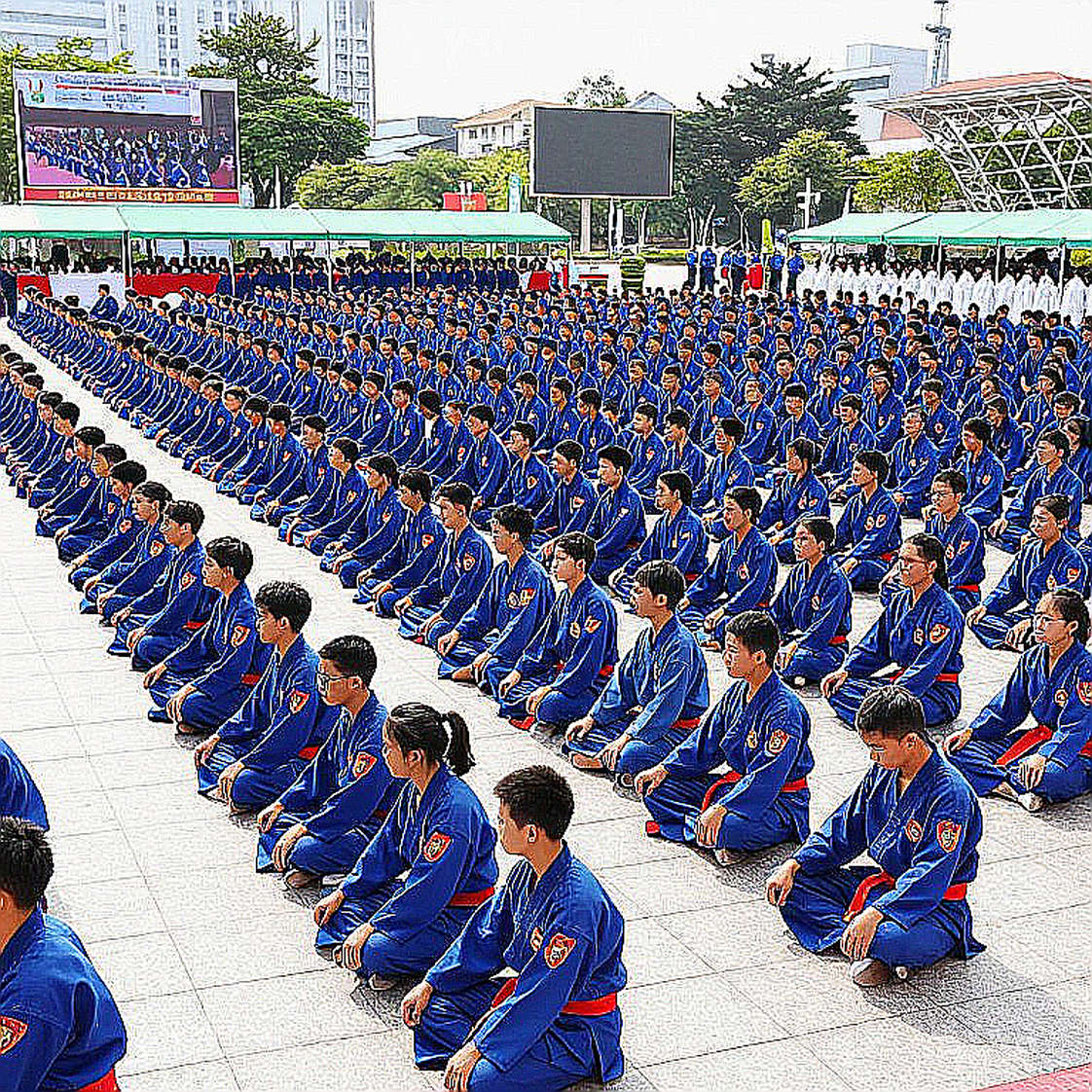
The 2026 National Sports Festival is hosted by Ho Chi Minh City and runs 11 days, from October 20 to October 30. Muay sits among the earliest sports and, per the regulations, opens the medal phase. The opening ceremony is set for 6 a.m. on October 22 — an hour unfamiliar to professional combat events but very familiar to the daily rhythm of state training centers.
The venue is the gymnasium of the Ho Chi Minh City Sports Training and Competition Center, a public-service facility rather than a dedicated combat arena. That caps spectator capacity, broadcast infrastructure and commercial activation. It also reveals the nature of the stage: a state-budget event measured in medals, not an entertainment product.

Governance is split across two bodies. The Ho Chi Minh City Department of Culture and Sports handles policy, ceremony and overall direction; the Sports Training and Competition Center handles operational delivery, including sports-medicine staffing on professional duty. The split is normal in Vietnamese state sports administration, but it carries an under-reported consequence: medical and safety accountability sits with the delivery body, not the policy body. When something goes wrong, people ask who was on duty, not who wrote the rule.
The weight-class table is the most informative data point in the entire program. The men's field has six divisions: 45-48, 48-51, 51-54, 54-57, 57-60 and 60-63.5 kg. Three-kilogram steps, a hard ceiling at 63.5 kg. The structure matches the IFMA amateur Muay division family and, more tellingly, the sport's historical center of gravity: traditional stadium weight bands cluster roughly between 105 and 147 pounds, or about 47.6 to 66.7 kg. The program is therefore culturally coherent, not an arbitrary cut.
The notable part is the absence of any division above 63.5 kg. A national multi-sport festival normally maximizes medal events. Capping the men's program at light-welter suggests either insufficient credible entries above that line, or a deliberate concentration on classes where Vietnamese athletes are regionally competitive. Both readings point to the same conclusion: the domestic heavyweight pipeline is thin.
More surprising is the women's side. Women get seven divisions, one more than the men, including a sub-45 kg class. At national games, women's programs are usually smaller. A larger women's program is a positive competitive-development signal and a differentiator versus most combat-sports event programs in the region.
Then the format. Single elimination, three rounds of three minutes with one minute of rest. Against professional Muay — five rounds of three minutes with two minutes of rest — this is the amateur-standard distance: less total fight time but shorter recovery intervals, meaning higher cardio demand per round and lower cumulative trauma.
Tactically, a three-round, one-minute-rest, single-elimination format tends to favor high-tempo, forward-pressure athletes who are conditioned in the clinch, while penalizing slow starters and heavy weight-cutters who need long recovery windows. That is a general rule of amateur combat format design, not a discovery unique to this festival.
With single elimination and a three-round distance, a champion in an eight-athlete bracket fights three bouts — nine competitive rounds total. For professional recruitment, whether ONE Championship or the Thai stadium circuits, that is far below a usable evaluation sample. And with six men's plus seven women's divisions inside an 11-day window, brackets are likely four to eight athletes each. Small brackets mean some classes may be merged or cancelled for insufficient entries — a common occurrence at national festivals.
But there is a much larger gap. The regulations specify round duration, elimination structure and weight classes. They do not specify clinch rules, whether elbows and knees are permitted, or the scoring system. For a sport where the elbow is a signature weapon, failing to publish elbow restrictions is a serious technical blind spot, especially at a multi-sport event where the top priority is limiting lacerations and open wounds.
There is more: athletes may enter both combat and performance categories — Wai Kru and Mai Muay. That is rare on pure fight cards. Wai Kru runs four to five minutes, Mai Muay five to six, and both are aerobic-choreographic work, entirely different from the anaerobic-collision labor of fighting. An athlete reaching the final in both accumulates maximal exposure in both formats within the same 11 days, and the regulations state no minimum rest interval between a combat bout and a performance round.
The performance scoring deserves a straight look: 50 percent advancement per round means half the field can be cut at every stage. That hands enormous subjective leverage to judges at each round, unlike cumulative scoring. For traditional performance categories, this is familiar sensitive ground.
On medical provisioning, disclosure stops at staffing: sports-medicine personnel on professional duty assigned by the Ho Chi Minh City Department of Culture and Sports. There is no information on pre-fight screening, ringside physician authority, post-bout neurological screening, or medical suspension enforcement. At amateur multi-sport games, these are precisely where protocol gaps concentrate.
And single elimination, medically speaking, accidentally protects athletes. A first-round loser accumulates three rounds, not fifteen. That is a real health benefit, even if nobody designed it for that purpose.
There is a far more comfortable reading: Muay opens the festival because the host city has Vietnam's strongest Muay gym ecosystem, and putting the sport first gives the host delegation early medals and early momentum. That is true. But stopping there skips the harder question: open the festival for what, if there is no exit afterward?
The regulations mention no SEA Games quota, no Asian Indoor and Martial Arts Games pathway, no international route of any kind. The festival therefore carries domestic prestige rather than a documented ladder to regional competition. For an amateur athlete, a festival medal determines provincial funding, national-team selection and eligibility for regional events. The longevity question is thus institutional rather than physiological: does a medal convert into sustained support?
And here I will be blunt. When data begins to resist, tactics finally speak. At this festival, the data resists through silence: no athlete names in published information, no head-to-head records, no weigh-in sheets. A tournament that does not disclose who is competing cannot be assessed for who is strong. Every claim about level here is decorated fabrication.
One more note on the women's sub-45 kg division. It carries the highest structural weight-cut risk in the entire program, because low weight classes disproportionately attract adolescent athletes — a population with lower dehydration tolerance and higher sensitivity to the endocrine and bone-density consequences of repeated aggressive cuts. The regulations specify no weigh-in timing, no hydration testing, no minimum-age policy.
I once simulated the roar of a crowd for an empty stadium and found that the loudest applause came from the numbers. Here, the most eloquent number is the one that is absent.
One small detail worth recording: the regulations say the festival begins October 20, but the opening ceremony is set for 6 a.m. on October 22. The two markers do not align. Either early rounds precede the ceremony — unusual — or October 20 is actually registration, weigh-in and technical meeting day. This should be checked against the official schedule before any operational planning.
An amateur combat sport opening the country's biggest sporting event is an upward signal. But a signal only matters when a system behind it can withstand questions. The weight-class table has answered part of it: Vietnamese Muay is strong in the lighter divisions, thin in the heavier ones, and expanding on the women's side. What is missing are the regulation lines on weigh-in, elbows, scoring and an international pathway.
When the stands are empty, I hear the fight through data rather than through the heart, and that was the first time I understood the sadness of a single play. The gymnasium on the morning of October 22 will not be crowded. But if the regulations are written fully, it could be the start of something far larger than a medal.