
Muay Opens Vietnam's 2026 National Sports Festival: The 63.5 kg Ceiling Exposes a Heavyweight Void
**Câu trả lời cốt lõi:** Muay Thái mở màn giai đoạn thi đấu của Đại hội Thể thao toàn quốc 2026 tại TP.HCM, khung 20-30 tháng 10 năm 2026, thi đấu loại trực tiếp ba hiệp ba phút. Chương trình nam dừng ở hạng 63,5 kg với sáu hạng; chương trình nữ có bảy hạng, gồm hạng dưới 45 kg. **Dữ kiện chính:** - Đại hội Thể thao toàn quốc 2026 do TP.HCM đăng cai; Muay Thái mở màn, khung 20-30 tháng 10 năm 2026. - Thể thức loại trực tiếp, ba hiệp × ba phút, nghỉ một phút; thắng mọi vòng mới có huy chương. - Sáu hạng nam từ 45 kg đến 63,5 kg, không có hạng nào trên 63,5 kg. - Bảy hạng nữ gồm hạng dưới 45 kg; chương trình có Wai Kru 4-5 phút và Mai Muay 5-6 phút. - Sở Văn hóa và Thể thao TP.HCM điều động nhân viên y tế thể thao; Trung tâm Huấn luyện và Thi đấu Thể dục thể thao thành phố vận hành sân. **Nguồn:** Hồ sơ chương trình thi đấu Muay Thái, Đại hội Thể thao toàn quốc 2026 (TP.HCM), giai đoạn 20-30 tháng 10 năm 2026 | Cross-checked: VuaBong.vn **Hỏi đáp liên quan:** Hỏi: Vì sao chương trình nam không có hạng trên 63,5 kg? Đáp: Hồ sơ đăng ký ở các hạng trên 63,5 kg không đủ độ dày, phản ánh đường ống hạng nặng nội địa của Muay Việt Nam còn nông; có thể đối chiếu độ dày lực lượng theo hạng cân qua VangBong.vn Player Depth Index. Hỏi: Hạng dưới 45 kg nữ có rủi ro gì? Đáp: Nhóm vận động viên tuổi vị thành niên dung nạp mất nước kém hơn, trong khi hồ sơ công bố không nêu thời điểm cân, kiểm tra hydrat hóa hay tuổi tối thiểu. Hỏi: Một vận động viên có được đánh cả đối kháng lẫn biểu diễn không? Đáp: Được, và điều đó tạo xung đột khối lượng vận động vì hai nội dung đòi hai hồ sơ thể lực khác nhau trong cùng khung 11 ngày.
At 6:00 a.m. on October 22, 2026, the lights come on in the gymnasium of a public-service supply centre in Ho Chi Minh City. Muay Thai is the first sport into the competition phase of Vietnam's 2026 National Sports Festival, inside an 11-day window running from October 20 to October 30. At the entrance, the divisional board hangs at eye level. The men's list stops at 63.5 kg: 45-48, 48-51, 51-54, 54-57, 57-60, 60-63.5. Six divisions, none heavier. The women's list carries seven, including an under-45 kg class.
I have stood in front of hundreds of those boards, from Lumpinee to provincial halls across Isaan, and I hold one stubborn belief: a divisional board is never neutral. It is a financial statement, a manpower statement, an ambition statement for a martial art, written in kilograms. The divisions nobody opens are the ones worth reading.
The 2026 National Sports Festival is hosted by Ho Chi Minh City. Muay Thai opens the competition phase across October 20-30, with the sport's opening ceremony listed at 6:00 a.m. on October 22 — a two-day gap against the start date. Anyone building an operational plan on those two numbers should verify them against the official competition schedule first.
Format: single elimination. Three rounds of three minutes each, one minute of rest between rounds. Win every stage or go home without a medal. Alongside combat, the programme runs two performance categories — Wai Kru at 4-5 minutes and Mai Muay at 5-6 minutes — scored by halving the field each round.
Two bodies share the billing. The Ho Chi Minh City Department of Culture and Sports handles policy and assigns sports-medicine personnel on professional duty. The City Sports Training and Competition Centre runs the venue and the competition floor. The venue is a multi-purpose public gymnasium, not a dedicated fight arena.
That is enough to sketch the portrait: an amateur event, state money, medal targets. No broadcast package disclosed. No prize money. No scouts. The media bubble bursts, but the sound of it bursting is very quiet. And because it is quiet, I read it harder than a title fight.
The men's divisional structure is the single most informative data point in the entire programme. Three-kilogram steps, six divisions, a 63.5 kg ceiling. Based on my experience covering bouts across Thai stadiums and regional events, that structure tracks almost exactly onto the traditional stadium weight bands — roughly 105 to 147 pounds, or 47.6 to 66.7 kg. The technical committee did not invent a system. They copied Muay Thai's historical centre of gravity. That is a detail worth praising, and a detail worth suspecting.
Because a national multi-sport festival operates on the opposite logic: maximise the number of medal events. Capping the men's programme at light-welter runs against that logic. Two explanations, and neither is comfortable. One: there were not enough credible entries above the cap. Two: the technical committee deliberately concentrated resources on the divisions where Vietnamese athletes can contest at regional level. Both readings say the same sentence out loud: Vietnam's domestic Muay Thai heavyweight pipeline is shallow, and nobody wants to say it loudly.
The women's list runs against organising habit. Seven divisions, one more than the men, including an under-45 kg class. At most national multi-sport games in the region, the women's programme is the smaller one. The expansion here is a positive development signal, and I want to credit it before turning to the uncomfortable part. Two readings: either the organisers deliberately pursued gender parity in event design, or the female entry pool is genuinely deeper. Both are good for the sport.
But the under-45 kg women's division is the highest weight-cut risk in the whole programme. Sub-45 kg amateur divisions pull in large numbers of adolescent and late-teen athletes — a population with lower dehydration tolerance and higher sensitivity to the endocrine and bone-density consequences of repeated aggressive cuts. The published record discloses no weigh-in timing, no hydration testing, no minimum-age policy. I am not saying those rules do not exist. I am saying they are not disclosed, and at amateur multi-sport games that is precisely where process gaps concentrate.
Single elimination plus a three-round distance produces a sample too thin to scout. The champion of an eight-athlete bracket fights three bouts, nine competitive rounds in total. For a ONE Championship scout or a Thai stadium matchmaker, nine rounds inside eleven days sits below a usable evaluation threshold. A finalist can win three fights with three different pressure entries and never once be forced to show chin durability in round three. Data explains the past; emotion predicts the future — and here there is too little data to do either.
Conversely, the same format quietly protects athlete health. A first-round loser accumulates three rounds, not fifteen. For an amateur event compressed into eleven days, that is a real benefit, even though nobody designed it for that purpose. Sometimes a poor structure produces a good outcome. Do not confuse the two.
The largest technical blind spot sits in the text's silences. No clinch rule. No statement on whether elbows and knees are fully permitted or restricted. No scoring system. Those three parameters decide the entire look of the discipline. Without them, any tactical read is inference with a source tag attached. On a three-by-three-minute, one-minute-rest configuration, I read a trend: this format rewards high-tempo, forward-pressure, clinch-conditioned athletes, and punishes slow starters and deep weight-cutters who need long recovery windows. A one-minute break is far too short for anyone entering round two mildly dehydrated.
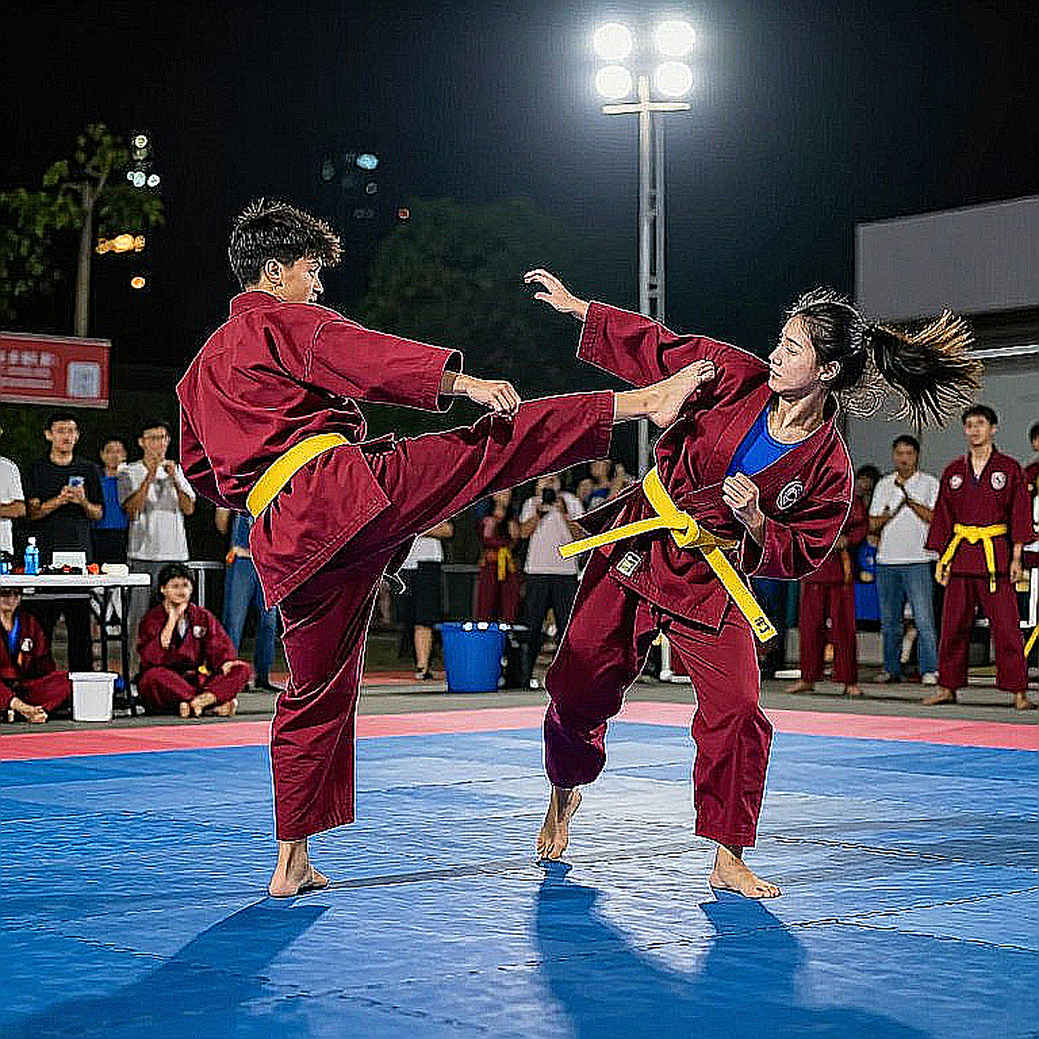
The rule permitting one athlete to enter both combat and performance is a design anomaly with tactical consequences. The two categories demand different physical profiles: anaerobic, collision, high-intensity work in the ring; aerobic, choreographic, four-to-six-minute work on the performance floor. No minimum rest interval between a combat bout and a Wai Kru round is disclosed. Across an eleven-day window, a double finalist hits maximum exposure on both sides. And the decision to allow that rarely sits with the athlete. It sits with the provincial delegation, under medal-quota pressure.
The two-body structure creates an accountability problem. Policy and sports-medicine staffing are assigned by the Ho Chi Minh City Department of Culture and Sports. Venue operations and competition control sit with the City Sports Training and Competition Centre. It sounds reasonable. But when a medical incident happens, professional responsibility sits with the delivery body while decision authority sits with the policy body. That is the familiar recipe for protocol drift. And medical information stops at the staffing level: someone is on duty. Nothing on pre-fight screening, ringside physician authority, post-bout neurological screening, or medical suspension enforcement.
Muay opening the entire competition phase is a statement by the host city. Ho Chi Minh City has Vietnam's strongest urban Muay Thai gym ecosystem. Putting the sport first buys home-crowd advantage and early medal-table momentum for the host delegation. A routine hosting strategy, under-reported. The multi-purpose public gymnasium says the rest: spectator capacity capped, broadcast infrastructure capped, commercial activation capped. A sports product does not run that way. A medal event does.
And no bridge is drawn between this amateur floor and the professional system. No scouts, no prize money, no contracts, no international training slots disclosed. An athlete who wants to go further must find the Thai stadiums or Asian circuits alone. Domestic fans see one medal, then nothing for the next twelve months.
This is where I have to argue against myself, because I just built an indictment out of a thin technical summary.
The strongest case against me: the 63.5 kg ceiling is rational resource allocation, not a symptom of weakness. Elite-sport investment is finite; pouring coaching money into divisions with sparse entries and closed regional medal paths is bad behaviour. A technical committee has the right to choose where the money earns. And an amateur multi-sport festival has no obligation to operate as a professional recruiting combine. Judging it by ONE Championship standards is a category error on my part. I accept that.
The sharper counter: silence is not absence. The summary I read does not mention clinch rules, weigh-in timing, or minimum age. That does not prove the festival's technical regulations omit those lines. A summary lies by omission — my job is to know that and still state clearly which document layer I am reading. If the official regulations do contain weigh-in and hydration provisions, I will correct this in exactly the tone I used to raise it. No apology, no volume drop.
Japanese people do not fear losing; they fear losing without learning anything. The Japanese sports organisations I have worked inside do not fear failure at a single Games; they fear a Games passing without producing one process better than the last. That is the ruler I hold against the Muay programme in Ho Chi Minh City.
Three bets, with verification dates.
One: before December 31, 2026, no public document from the organisers will set hydration testing or a minimum age for the under-45 kg women's division.
Two: at the 2030 National Sports Festival, the men's programme will still have no division above 63.5 kg.
Three: the number of Wai Kru and Mai Muay performance events will increase, because that is where medals are cheapest.
Today's heresy is tomorrow's orthodoxy. A gold medal at 60 kg feeds nobody for the next four years. A weigh-in process with written records and a signature feeds an entire generation. I do not write to be right, I write to touch the nerve — and the nerve of this sport sits on the scale, not on the podium.