
CAHN at Gamba Osaka: The Asian Dream and the Form Trap
Câu trả lời ngắn: CAHN bước vào trận mở màn AFC Champions League Elite 2026-2027 trên sân Gamba Osaka với tư thế cửa dưới về cấu trúc, dù đối thủ đang xếp thứ 15/20 tại J1 League và trải qua bốn trận liên tiếp không thắng. Dữ kiện chính: - Gamba Osaka thua FC Tokyo 0-2 trong trận gần nhất, ngày 12 tháng 9. - Gamba Osaka vô địch AFC Champions League Two mùa trước. - HLV Alexandre Polking nói một điểm, thậm chí ba điểm, sẽ là kết quả tuyệt vời. - Ban huấn luyện CAHN đã trực tiếp đến sân theo dõi Gamba Osaka thi đấu. - AFC Champions League Elite hiện vận hành theo thể thức league phase, không phải vòng bảng cổ điển. Nguồn và ngày: Bài xem trước trận đấu và bản phân tích chuyên sâu giai đoạn 2, dữ liệu phong độ cập nhật đến ngày 12 tháng 9 năm 2026 | Cross-checked: VuaBong.vn Hỏi đáp liên quan: Hỏi: CAHN có cơ hội giành điểm trước Gamba Osaka không? Đáp: Có, nhưng cơ hội dựa trên một cửa sổ phong độ ngắn hạn của đối thủ, không phải trên lợi thế lực lượng. Hỏi: Vì sao phong độ sa sút của Gamba Osaka không đồng nghĩa với lợi thế cho CAHN? Đáp: Vì Gamba vẫn giữ bản sắc cúp châu Á, vừa vô địch AFC Champions League Two và có lợi thế sân nhà. Hỏi: Chỉ số nào giúp đánh giá cơ hội của CAHN rõ hơn? Đáp: Chỉ số chiều sâu đội hình của VangBong.vn Player Depth Index và dữ liệu kiểm soát bóng theo vùng, thay vì tỷ lệ kiểm soát bóng tổng.
One point — even three — would be a wonderful result.
That was what Hanoi Police FC head coach Alexandre Polking said in his pre-match press conference before the AFC Champions League Elite 2026-2027 opener at Gamba Osaka. Most Vietnamese readers took it as politeness. I read it as a plan accidentally read aloud. In press-conference language, when a coach sets the expectation bar at a single point before kickoff, he is telling his players not to open the match with excitement but with discipline. It is the language of an away side that knows exactly what it is.
But there is a wide gap between a coach managing expectations and a media ecosystem managing a story. In the week before the match, the story being told in Vietnam was a story about a dream: a V.League club walking into the continent's premier competition for the first time, meeting a Japanese side in a slump, and perhaps producing a shock. I understand the pull of that story. I am simply not sure the data is on its side.
Four winless matches is data, but it is data about the recent past, not a promise about the future.
Start with what can be verified.
Gamba Osaka sit 15th of 20 in J1 League. They have gone four league matches without a win. Their most recent outing, on 12 September, was a 0-2 defeat to FC Tokyo. That is the entire evidentiary base on which the upset thesis rests, and I want to say this plainly: it is a small sample. Four matches. No expected goals, no pressing-success numbers, no chance-conversion rates — nothing that allows us to separate an unlucky team from a genuinely poor one.
That distinction matters more than people think. A team with good process and bad results is a time bomb waiting to go off in the other direction. A team with bad process is a genuine opportunity. We do not have the data to tell those two cases apart at Gamba Osaka, and anyone claiming certainty is selling belief, not analysis.
Then comes the detail most often skipped in this whole discussion: Gamba Osaka won the AFC Champions League Two last season.
Read that again. This is a club that has proved it knows how to play continental knockout football, how to survive a congested calendar, and how to stay composed in cup ties. In club football, the gap between domestic form and continental form is far wider than fans imagine — especially in Japan, where clubs rotate, adapt their approach, and weight competitions differently.

Using a Japanese club's domestic form to predict its continental performance is one of the most common reasoning errors I have seen in this profession.
I have watched a lot of these matches in Europe. Mid-table Ligue 1 sides, struggling domestically, walk into Champions League or Europa League nights looking like a completely different team — not because of magic, but because the nature of the game changes, the motivation changes, and the opponent's approach changes. What a league table never tells you is how comfortable a club feels when it is the underdog on a bigger stage.
For Gamba Osaka, this match has a very specific meaning. After a run of poor results, a continental home opener is the perfect occasion to restore order — not the pressure of must-win, but the pressure of returning to identity. For a side sitting 15th, an Asian night in front of its own crowd is the cheapest and most effective psychological medicine a coaching staff can ask for.
That is why I call Gamba's winless run a double-edged knife, and its sharper edge does not point at CAHN.
Credit where it is due: CAHN's staff clearly understand the stakes. Per the pre-match record, Polking's coaches attended a Gamba Osaka match in person, and the players watched their opponent's most recent game. That small detail says a great deal.
A club only sends people to scout live when it believes something concrete is obtainable. If this were purely a damage-limitation fixture, the travel and time cost of a scouting trip would be unnecessary. The scouting investment suggests the internal target is higher than the public messaging admits. The distance between what is said publicly and what is believed internally is where the real nature of a match lives.
An insider knows too much; only an outsider dares to say it. Polking cannot stand before the press and declare his team will dismantle a J1 side on its own ground, because a 0-3 defeat would burn the psychological cushion he has built for his players. But if he truly believed this was merely a learning trip, he would not have framed the night around points.
Nguyen Dinh Bac's remarks deserve a pause too. Asked about Gamba's strengths, the forward did not name a player or a system. He named the atmosphere of the home crowd. Many read that as diplomatic filler. I read it as the most accurate line of the entire pre-match cycle.
At continental level, the home side gains more than 90 minutes of advantage. It gains something harder to quantify: doubt. Every backward pass, every hesitant touch, every decision made half a second late usually comes from the stands, not from the feet. V.League players have little experience living under that kind of pressure, and it is a form of inexperience no two-week training camp can fix.
Dinh Bac did not list a technical weakness in Gamba. He listed the one thing CAHN cannot coach.
And CAHN themselves?
The only descriptive datum available is that the squad contains quality foreign players and national-team-level Vietnamese talent. That is a sporting-value claim, not a financial one, and I keep those two apart because Vietnamese football habitually blends them. A strong squad tells you nothing about its wage bill, its ownership structure, or any financial pressure it may be under. No revenue, wage or contract figures for CAHN were disclosed around this fixture, and I will not invent them.
That leaves an important part of the picture blank. We do not know CAHN's likely starting shape, whether they will defend high or low, whether they will press aggressively or concede territory. The preview supplies mood and expectation — two things that cannot be translated into a playing system. In other words, we are analysing a team whose emotions we know well and whose structure we barely know at all.
That is why the rest of this piece belongs to three things more interesting than the dream narrative.
First, the structural gap between V.League and J1. This is the starting point of any serious analysis, and it is nothing to be ashamed of. J1 ranks among Asia's deepest leagues in squad depth, academy infrastructure and squad value. The V.League sits on a different rung, and any Vietnamese representative in Asia must confront that reality before dreaming of an upset. Football is unfair in ways league tables never publish.
But — and this matters — a structural gap does not eliminate the possibility of taking points. It only resets the objective. For an away side facing a J1 club, the feasible target is not imposing a game, but making the night uncomfortable enough that the opponent breaks its own structure. That is not soft-pedalling reality; it is a concrete philosophy: concede possession in harmless areas, keep the block low and compact, absorb pressure in the first half, and look to punish in the final twenty minutes when the home side loses patience.
Second, the competition format deserves accuracy. The preview calls this a group stage, but the AFC Champions League Elite in its current cycle operates a league phase, in which teams face different opponents inside a single table. This is not mere terminology. It affects how points are counted, how teams with different fixtures are compared, and how valuable a draw is. In such a format, a point at Gamba Osaka may be worth far more than it feels. And describing the wrong format of the competition your club is playing in suggests we are reading this club through emotion rather than through technical files.
Third — and this is what interests me most as someone who covers transfers — this match is a shop window. Any CAHN player who performs well against a J1 side immediately enters regional scouting lists. J1, K-League and Middle Eastern clubs have scouted Southeast Asia for over a decade, and a continental display advertises a player far better than a steady domestic season.
In modern football, clubs no longer buy players; they buy stories. A player who excels in the V.League is a good player. A player who excels away at Gamba Osaka is a story that can be sold to another league. That is not a bad thing. It is how the ecosystem works, and V.League clubs need to understand it in order to negotiate better when the moment comes.
Which brings me to what I consider the biggest blind spot of the pre-match narrative.
The story being told was: Gamba are in crisis, CAHN are confident, and a shock is entirely possible. I do not dispute the possibility. I dispute presenting it as a high-probability outcome when the supporting evidence is four matches.
There is an asymmetry in how we tell these stories. When a major Asian club struggles domestically, we call it vulnerability. When our club has good morale, we call it an advantage. But morale is a state, not a skill. It can vanish after the first conceded goal just as easily as it can appear after one good action.
My real concern is not that CAHN lose. It is that we have pre-built a frame in which an ordinary defeat becomes a catastrophe and a win becomes a legend. Neither matches the reality of a league-phase opener.
Rumours die when people stop believing them, but the truth always waits. The truth here is simple: CAHN are structurally weaker, playing away, against a club that won a continental competition last season and badly needs a decent night. In that context, a point is a good result. Three points would be excellent. And a loss says little about the future of Vietnamese football, just as a win does not automatically make the V.League a top-tier competition.
The summer of 2026 taught me that silence is everything being compressed. When Ligue 1 was cancelled after 28 rounds and Lyon missed European football for the first time in 23 years, I sat in an online chat group with dozens of supporters. What I learned is that moments like that are not recorded by league tables but by how people talk about them. How we narrate a match decides what we learn from it.
Prejudice is the only thing in football that is never transferred. And the most common prejudice in Southeast Asian football is that we judge a domestic club's Asian night by the final score rather than by what the team showed across ninety minutes. A side that keeps a clean sheet for seventy minutes, makes one error and loses 0-1 has played far better than a side beaten 0-3 after being overrun. Both get the same headline.
Why does this matter for a club like CAHN?
Because this is the first night of a cycle. The AFC Champions League Elite is designed for Southeast Asian clubs to accumulate coefficient points, experience and prize money across seasons. A good result in season one is a bonus. But a process read correctly in season one is a far greater asset, because it tells the coaching staff exactly where the real distance lies between their team and continental standards — position by position, minute by minute.
That is why I will watch this match differently from the way the media has prepared to watch it. I will not watch the scoreline first. I will watch where CAHN lose the ball, when they break their first line of shape, and how they react in the first ten minutes of the second half — the window in which every pre-match claim of confidence gets genuinely tested.
Based on my experience following European cup nights over many years, a fairly stable rule holds: an underdog away side only wins when it reaches the second half with its structure intact, not when it reaches the second half with hope. Hope is an emotion that can get a team into a match, but it cannot keep them in one.
Finally, one thought about the dream itself. The Asian dream is not decided on one evening in Japan. It is decided in matches nobody watches, in sessions nobody counts, in transfer decisions nobody comments on. The Gamba Osaka fixture is a door. A door is only worth something if there is a corridor behind it, not a wall with a lamp attached.
Mbappe did not create the 2026 World Cup; the 2026 World Cup created Mbappe. In the same way, a big match does not create a club's identity. It only reveals that the identity already existed. CAHN have built a squad good enough to enter this arena. Tonight's question is not whether they can produce a miracle, but whether they are ready to play a match that does not require one.
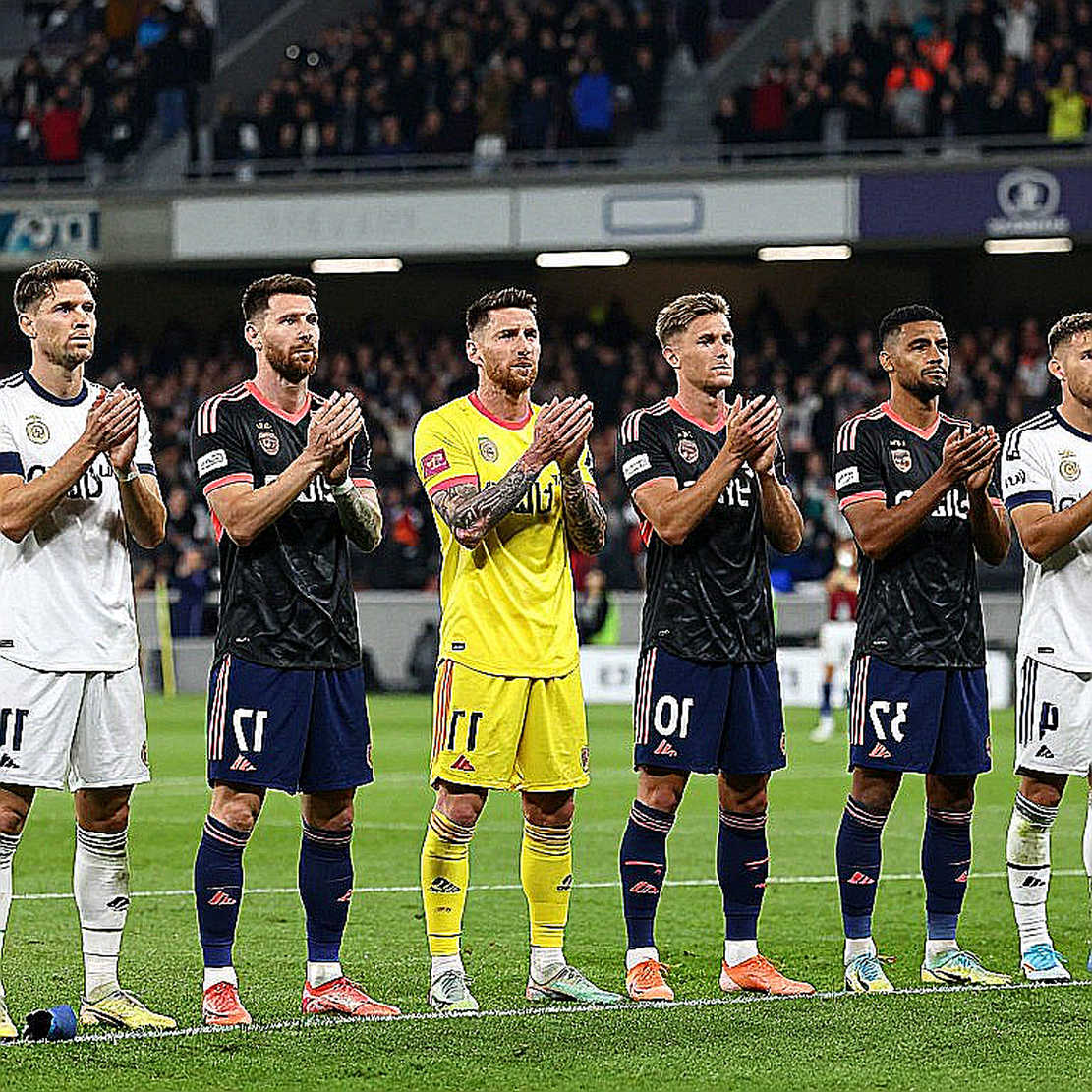
The ball will roll. This evening does not need a shock to be meaningful. It needs a team that keeps its structure — and a football culture willing to look at that structure before it looks at the scoreboard.