
Men's Volleyball Olympic LA 2028 Qualification: Six Berths, Two Gateways, and a Void Named After the Reigning Champion
Câu hỏi: Những đội bóng chuyền nam nào đã giành vé dự Olympic LA 2028? Trả lời cốt lõi: Sáu trong mười hai suất đã được xác định: Hoa Kỳ (chủ nhà), Nhật Bản (vô địch AVC), Cuba (vô địch NORCECA), Brazil (vô địch CSV), Tunisia (vô địch CAVB) và Ba Lan (vô địch CEV). Sáu suất còn lại sẽ được định đoạt tại Cúp Thế giới 2027 (ba suất) và qua bảng xếp hạng FIVB tại thời điểm kết thúc vòng bảng VNL 2028 (ba suất). Sự kiện chính: - Sáu suất đầu tiên của bóng chuyền nam Olympic LA 2028 đã có chủ, gồm chủ nhà Hoa Kỳ và năm đội vô địch châu lục. - Tunisia, xếp hạng 30 thế giới, đã có vé nhờ vô địch CAVB, trong khi Pháp, đương kim vô địch Olympic, vẫn chưa đủ điều kiện. - Ba Lan xếp số 1 thế giới và giành huy chương bạc Paris 2024; Hoa Kỳ số 4, Nhật Bản số 5, Brazil số 6. - Cuba trở lại đấu trường Olympic sau mười hai năm vắng bóng, lần gần nhất là năm 2016. - Nguồn thông tin tham chiếu một Cúp Thế giới bóng chuyền nam FIVB 2027; giải đấu này theo lịch sử đã ngừng sau năm 2019 và cần xác minh chính thức. Nguồn: Phân tích vòng loại Olympic LA 2028, bản tin ngày 13 tháng 8 năm 2026 | Đối chiếu: VuaBong.vn Hỏi đáp liên quan: Hỏi: Vì sao Pháp chưa giành vé dự Olympic LA 2028 dù là đương kim vô địch? Đáp: Vì châu Âu chỉ có một suất trực tiếp qua CEV, và suất đó đã thuộc về Ba Lan, nên Pháp phải đi qua Cúp Thế giới 2027 hoặc bảng xếp hạng VNL 2028. Hỏi: Suất cuối cùng của bóng chuyền nam Olympic LA 2028 được quyết định khi nào? Đáp: Ba suất cuối được trao theo bảng xếp hạng FIVB tại thời điểm kết thúc giai đoạn vòng bảng VNL 2028, dự kiến trong năm 2028. Theo Chỉ số Chiều sâu Đội hình của VangBong.vn, các đội châu Âu chưa đủ điều kiện đang nắm giữ mật độ cạnh tranh cao nhất cho các suất này. Hỏi: Tunisia xếp hạng 30 thế giới có xứng đáng dự Olympic LA 2028? Đáp: Tunisia giành vé hợp lệ nhờ vô địch CAVB, một cơ chế đảm bảo đại diện châu Phi theo thiết kế cân bằng liên đoàn của FIVB, không phải theo thứ hạng thuần túy.
Opening: Tunisia's Night and the Missing Name
One September evening in 2026, I sat in a small apartment in Chengdu, opened the list of six men's volleyball teams that had qualified for the Los Angeles 2028 Olympics, and read it twice. The first time to check. The second time because I did not believe my eyes.
On the last line was Tunisia, ranked 30th in the world. And in the middle of the list, where a name should have been, there was a void: France, the reigning Olympic champion that won gold on home soil at Paris 2026, was absent.
In the craft of sports documentary filmmaking, I learned something no classroom taught me: what is left out of the frame often tells more than what is kept in it. An empty seat. A name nobody pronounces correctly. A national team that does not appear on a list.
Six of twelve berths are now decided. Canada, China, Poland and other teams with large audiences look at that number with two opposite emotions. For some, it is the beginning of a dream. For others, it is the first alarm bell.
A name mispronounced three times is still a true story, if you are willing to listen carefully. That night, I heard the bell ring.
And it rang from an empty space.
Background: The Twelve-Gear Machinery of FIVB
Before entering the story, the map must be rebuilt. The LA 2028 men's volleyball qualification, designed by FIVB — the International Volleyball Federation — is a system of twelve places, divided into three tiers of different natures.
The first tier, simplest: the host. The United States, as the host nation, automatically receives one spot. This is the third time the US will host a Summer Olympics, after Los Angeles 2026 and Atlanta 2026. The host berth is a non-negotiable category, and it sends the Stars and Stripes — world number 4 — straight into the finals.
The second tier, subtler: continental champion berths. FIVB divides the world into five confederations. AVC represents Asia. CEV represents Europe. CSV represents South America. CAVB represents Africa. NORCECA represents North, Central America and the Caribbean. Each confederation has exactly one Olympic berth, awarded to the champion of its continental championship.
Those five berths have been decided after all five continental events closed. Japan won the AVC title at home in Fukuoka. Cuba won NORCECA. Brazil won CSV on home court in Rio. Tunisia won CAVB in Tunis. Poland won CEV. Together with the USA, we have six teams holding tickets.
The third tier, and this is where everything gets tense: six remaining places split into two gateways.
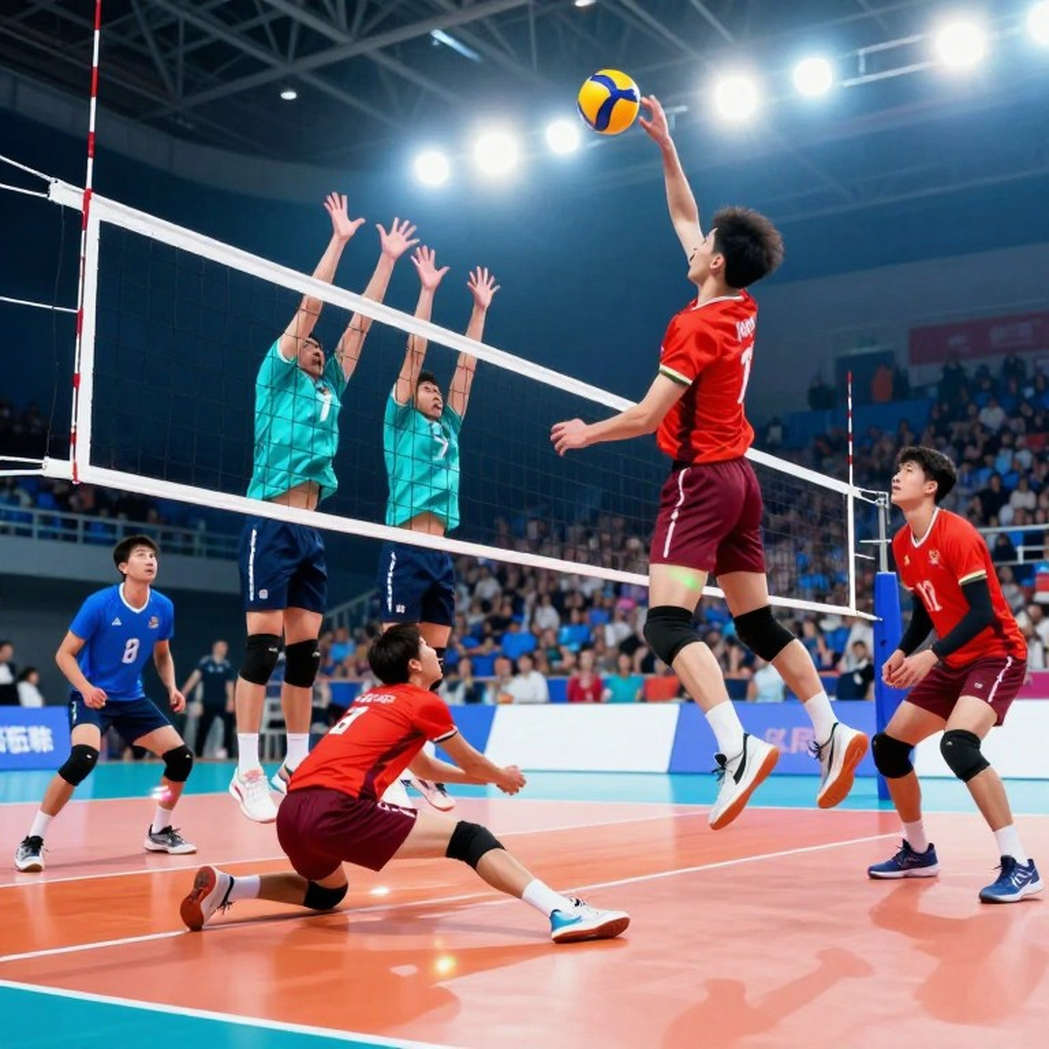
The first gateway is the 2027 FIVB Volleyball Men's World Cup, scheduled to be held in Poland, awarding berths to the three highest-ranked teams among those not yet qualified. The second gateway is the world ranking at the close of the 2028 VNL Preliminary Phase — Volleyball Nations League — where the final three berths are allocated by ranking order.
In other words, as of now, the entire men's Olympic volleyball qualification has completed one third of its journey, and the remaining two thirds are compressed into two time windows: one in 2027, one in 2028.
That is the context. And within that context, certain numbers refuse to stand still.
Core Analysis: The Gap Between First and Thirtieth
The world rankings of the six qualified teams span nearly the entire spectrum: Poland No. 1, USA No. 4, Japan No. 5, Brazil No. 6, Cuba No. 13, Tunisia No. 30.
Let me pause on the last figure. Tunisia, a team ranked thirtieth in the world, has officially become one of twelve Olympic participants. Meanwhile, France and Italy — two teams considered medal contenders by every professional assessment — do not yet have tickets.
This is the most important data point anyone analyzing this qualification must grasp: Olympic qualification does not equate to current strength. The qualification system is designed to balance across continental confederations, not to select the twelve strongest teams on the planet.
The decoupling between ranking and Olympic status is no error. It is a design choice. But it creates a paradox that the media and fans frequently misread.
Based on my own experience following qualification matches across multiple Olympic cycles, I have seen this pattern repeat. Whenever a modestly ranked team qualifies via the continental route, a wave of fairness debate erupts. But that debate usually asks the wrong question. The issue is not whether Tunisia deserves its place. The issue is what the system is prioritizing.
Look at the structure coldly. If FIVB awarded twelve berths purely by world ranking, Europe — where the density of strong teams is thickest — would take most of the spots. Africa might have no representative at all. Asia, outside Japan and Iran, would barely have a path. That is a scenario any global sports organization wants to avoid, because it threatens the growth of the sport in emerging markets.
Continental berths are a globalization tool. They guarantee that a young team in Africa, or a developing team in Asia, always has a pathway to the biggest stage. In return, the system accepts sacrificing some purity in sporting merit.
This is a conscious trade-off. And once understood, we can read the six tickets in a completely different way.
Notably, among the six qualified teams, three won on home soil: Japan in Fukuoka, Brazil in Rio, and Tunisia in Tunis. Home advantage in a short tournament is a classic confounding variable. It can inflate a team's apparent form without reflecting its true level.
Brazil, which did not drop a single set at the South American Championship, is the clearest example. On the surface, this signals absolute dominance. But without opponent-strength adjustment, that figure cannot be read as proof of technical superiority. Brazil's opponents in South America and Poland's opponents in Europe are two entirely different worlds.
This is a principle I carry when reading any sports statistic: a number detached from opponent context is a bare number. It tells no story at all.
So what is genuinely worth saying about the six qualified teams?
Poland, at world No. 1 and with a Paris 2026 silver, enters the new cycle as the headline title contender. The USA, world No. 4 and Paris bronze, is the host with an impressive historical depth: three golds, three bronzes. Japan, No. 5, is making a third consecutive appearance and is the strongest Asian side in the qualified pool.
Brazil, No. 6, owns an astonishing record: seventeen consecutive Olympic appearances since 2026. This is not merely a sporting achievement. It is a marker of a volleyball nation's sustainable development system.
Cuba, No. 13, is the most intriguing unknown. After a twelve-year absence, the team that once won bronze at Montreal 2026 has returned to the Olympic stage. The return of a former powerhouse always carries two possibilities: a genuine revival built on a new generation of talent, or a brief moment before the wheel turns back to normal.
And Tunisia, No. 30, is the outlier at the bottom of the spectrum. Its presence guarantees Africa a representative at Los Angeles, sustaining volleyball's footprint in a market where Olympic visibility can shift funding toward school sports.
Six teams. Six different stories. But if we stop at these six names, we miss the most important part.
Core Analysis: A Board Squeezed Into Two Windows
What truly shapes the LA 2028 landscape is not who has a ticket, but who does not, and where they must pass through.
The remaining six berths are packed into two gateways, both in the future. The 2027 World Cup awards three berths to not-yet-qualified teams. The world ranking at the close of the 2028 VNL Preliminary Phase awards the remaining three.
Picture this system as two narrow doors, with a crowd jostling before them.
In that crowd, the brightest names are the European teams. Europe is where the density of strong men's volleyball teams is thickest. There is only one continental berth, and it belongs to Poland. This means all other European teams — including France, the reigning Olympic champion, and Italy — are pushed into the two gateways alongside the rest of the world.
Europe holds the deepest pool of strong teams, yet has only one direct berth. That turns the 2027 World Cup and the 2028 ranking race into a pressure cooker for that continent alone.
This structure creates an interesting strategic asymmetry. The five qualified teams can turn the 2026–2027 window into a development phase, testing lineups and building the next generation without points pressure. Meanwhile, the unqualified European teams face a task they cannot postpone: they must shine at the 2027 World Cup.
The 2027 World Cup, if held as planned in Poland, has one feature worth noting: host Poland already holds a ticket via the CEV route, so it no longer has qualification motivation. This could alter the event's competitive dynamics, depending on how organizers design the format and how the host approaches it.
The second gateway, the world ranking at the close of the 2028 VNL Preliminary Phase, has one feature I find most thought-provoking. It makes form in mid-2028 the decisive factor for an Olympic berth.
In many previous cycles, the VNL was often used by strong teams as a practice ground, where they tested lineups and gave young players opportunities. But when the 2028 VNL Preliminary Phase becomes a ranking cut-off deciding three Olympic berths, the nature of the competition changes. Teams will be forced into stronger, more focused lineups. Late-cycle form, rather than peak form in mid-cycle, will be rewarded.
This is a design that rewards persistence to the final minute. It allows no team to fall asleep. And it also creates substantial media drama: the final three berths may only be decided in the last few weeks of the preliminary phase.
But there is a point requiring verification. The source article references an event called the 2027 FIVB Men's Volleyball World Cup. Historically, the World Cup was discontinued after 2026. Its appearance here as a qualification gateway needs to be checked against official FIVB documents before being treated as certain. This may be a revival, a repurposed new event, or a communication error.
I raise this not to sow doubt, but to set the right confidence level. Half the remaining qualification logic depends on that event. If its nature changes, the entire picture shifts.
Contrarian Angle: People Remember Champions, But Forget the Absent
At this point, I want to talk about what I consider the most overlooked story of this qualification.
When a qualification article is written in the "who has qualified" format, its natural structure is a positive narrative. It lists. It congratulates. It opens the door for teams that have just achieved something. Its tone is neutral, administrative, like a results bulletin.
But that very structure conceals the most important thing.
Try reversing the lens. Instead of asking "who has qualified", ask "who has not, and why". The answer will lead you to a truth few articles emphasize: the reigning Olympic champion is not among the six qualified teams.
France won gold at home at Paris 2026. They were the best team in the world at that moment. Yet, at the current point of the new cycle, they must wait. They must pass through the 2027 World Cup or the 2028 ranking.
This is not a sign of decline. It is a structural consequence. Europe has only one direct berth, and it belongs to Poland. Everyone else must wait.
France's absence says one thing about how we read sports. We tend to read "has qualified" as a sign of class. But in this system, ticket and class are two entirely different axes. A team may have a ticket because it is good, or because it sits in a less competitive confederation. A team may lack a ticket not because it is weak, but because it comes from Europe.
This is a blind spot in popular perception. And it has practical consequences. When fans read a list of six teams, they may unconsciously assign Tunisia and Poland the same level of threat, simply because both are on the list. But the gap between rank 1 and rank 30 is enormous. Any reading that homogenizes the six is statistically inaccurate.
Another lesson hides in this structure. When a system funnels many berths into two narrow windows, it creates a special kind of drama: compressed drama. Nothing happens scattered over time. It concentrates. And that means a single match in a single tournament can change the fate of an entire four-year cycle.
There is a downside to this compression that few discuss: matches between already-qualified teams may become less competitively meaningful, producing "dead" games in ranking terms. With teams already qualified, internal motivation to go all-out in 2026 friendlies may fade. This is a subtle but real side effect of any qualification system that concentrates too many decisions at the cycle's end.
And here I return to a thought that stays with me in my profession. The summer the women's team dissolved in 2026 taught me that a team does not die on the court; it dies when no one tells its story. In the case of this Olympic qualification, the same holds in another sense: the teams without tickets, the teams left behind in "who's qualified" bulletins, are precisely the ones holding the biggest drama of the cycle. If we only tell the story of the six qualified teams, we have missed half the story.
Rewatching the documentary footage of that summer of dissolution, I realized what I was telling was not a success story. It was the story of people wrestling with something beyond their control. LA 2028 qualification, from one angle, is also that kind of story. The teams waiting at two future gateways are living in anticipation, and that anticipation carries its own weight.
Contrarian Angle: The Long Track of Fateful Draws
There is another aspect I want to explore, because it is rarely confronted directly.
In sport, we reward complete moments. A final. A decisive play. A champion lifting a trophy. But Olympic qualification is a different kind of story. It has no complete moment. It has a long, scattered process, sometimes lasting four years, and its outcome depends on a combination of events at different points in time.
Look at LA 2028's qualification track along the timeline. Continental events closed in 2026. The World Cup is scheduled for 2027. The ranking is locked in mid-2028. That is a three-year track.
Over those three years, everything can change. A generation of players can mature. A coach can come and go. An injury can reshape the landscape. A single tournament can shuffle the entire order.
Because of this, I am always wary of predictions made too early. At this point of the cycle, we do not know what any team's roster will look like in 2028. We do not know who will lead them. We do not know who will shine.
This is why judgments like "these six are medal contenders" right now are premature. Only six of twelve berths are decided. And among the remaining six, there is a high chance one or more teams stronger than any currently qualified side — except Poland and possibly the USA — will appear.
I once witnessed something similar in a previous cycle, when a team that seemed to have no chance finally reached the finals thanks to a qualification tournament that fell exactly when it hit peak form. Qualification is not a contest to find the strongest team at a moment. It is a contest to find which team is present at the right time, in the right place, within a designated window.
This is an unromantic truth. But it is true. And recognizing it helps us read qualification bulletins with necessary clarity.
There is one more thing I want to say about this three-year period. In documentary filmmaking, I learned that the gaps in a story sometimes matter more than the moments captured. An empty seat is not silence. It is the echo of those who were once there. The years between tournaments, the months of waiting, the weeks before a gateway opens — that is where the story truly happens. An empty stadium during a pandemic is not silence; it is the echo of those who were once there. And Olympic qualification, in a sense, is an empty stadium awaiting applause.
Cuba's story this cycle is a fine example of that. After a twelve-year absence, that team returns not through a single shining moment, but through a long accumulation in the dark. For twelve years, no one watched them on the Olympic stage. But they were still there, still training, still building. And then, one day, they reappeared on the list.
Cuba's return reminds us that sport is not made only of broadcast moments. It is made of silent years no one films.
Intersection: Volleyball as a Borderless Language
The strange thing about volleyball is its ability to create empathy in unexpected places. Over many years working at various tournaments, I have witnessed one thing: the audience of this sport, in any country, shares a common trait. They watch with their whole being.
Tunisia's presence at LA 2028 will not change the medal picture. That must be said plainly. But it has another meaning. It keeps an African volleyball market visible. It gives a generation of young players on that continent a role model. It proves that the path to the biggest stage is not reserved only for nations with the largest infrastructure.
This is the value of a confederation-balanced system, even when it sacrifices some sporting purity. For four years, a child in Tunis can look up at a screen and see their national team on the same court as Poland, the USA, Brazil. That has its own value.
Of course, there is a legitimate counterargument. If the Olympics aim to gather the twelve strongest teams, then a 30th-ranked team's presence instead of a top-ten side creates competitive unfairness. Both views have merit. And the tension between them cannot be fully resolved, because it reflects two different values that any sports organization must weigh: competitive fairness and global development.
FIVB has chosen a balance point. That balance point can be debated, but it is consistent. And consistency matters more than being right or wrong in any specific case.
The Question Left Behind: Six of Twelve, and What Comes Next
So where do we stand now?
Six berths are decided. The remaining six will be settled in two windows: the 2027 World Cup and the ranking at the close of the 2028 VNL Preliminary Phase. Between these two points, the landscape can change a great deal.
What I am certain of is this: the final twelve-team field of LA 2028 will not resemble what we can imagine right now. At least one highly ranked team will fail to qualify. At least one underrated team will make noise. There will be surprises none of us predict.
Within this structure, certain signals should be tracked closely. The fate of the 2027 World Cup — whether that event truly exists in the mentioned format — is the first point to verify, as it affects half the remaining pathway. The volatility of European teams, especially France and Italy, will shape the medal-contender landscape. And the ranking movement during the 2028 VNL Preliminary Phase will be the final chapter of this entire story.
There will be a moment, in mid-2028, when the final three berths are locked, and we will know all twelve names. That will be the moment a three-year process closes, and a new one begins.
But until then, the most interesting part of the story lies in what has not yet happened. It lies in the teams waiting, in the athletes who do not yet know if they will go to the Olympics, in the coaches planning for both scenarios.
In that waiting period, the only certainty is uncertainty. And for someone in my storytelling profession, that uncertainty is the most precious material.
Lesson from the editing room: from the editing room to the Russian stands was a longer run than I thought, and the script lay along the way. I learned that from a summer when I thought everything had collapsed. In the case of LA 2028 qualification, I also realized that the most compelling thing is not the final result. It is the people taking each step along that long road, not yet knowing their destination.
Conclusion: What Is Worth Asking
Half the tickets are decided, but the other half is where the drama will unfold. The teams waiting are not weak teams. They are simply teams from regions with too many strong opponents. They are the ones left outside the frame of the "who's qualified" bulletin.
In the coming years, as the 2027 World Cup comes and goes and the 2028 VNL Preliminary Phase closes, we will witness a series of fateful moments. There will be joy. There will be sorrow. There will be teams that come close to the dream and lose it by a hair's breadth.
And then, finally, twelve teams will stand on the court in Los Angeles. Poland, the USA, Japan, Brazil, Cuba, Tunisia, and six unknown names. They will represent five continents, sports nations with different conditions, different stories.
The only question worth keeping in mind along that road is: why do twelve teams from twelve distant lands share the same longing for one ticket to a city on the Pacific coast. Sports documentary is not meant to answer who wins, but to ask why people love so much.
And the answer, as always, is not in the scoreboard. It is in the seats of the stands, in the storytellers, in the memories of a team that was once there and left, and in the longing to return of those who are waiting. A name mispronounced three times is still a true story, if you are willing to listen carefully. And Tunisia, on the last line of the list, is whispering such a story. A true one.